Con el acuerdo de Bayer sobre flubendiamida, Tagros Chemicals refuerza su enfoque en la distribución global
 18 de febrero de 2026
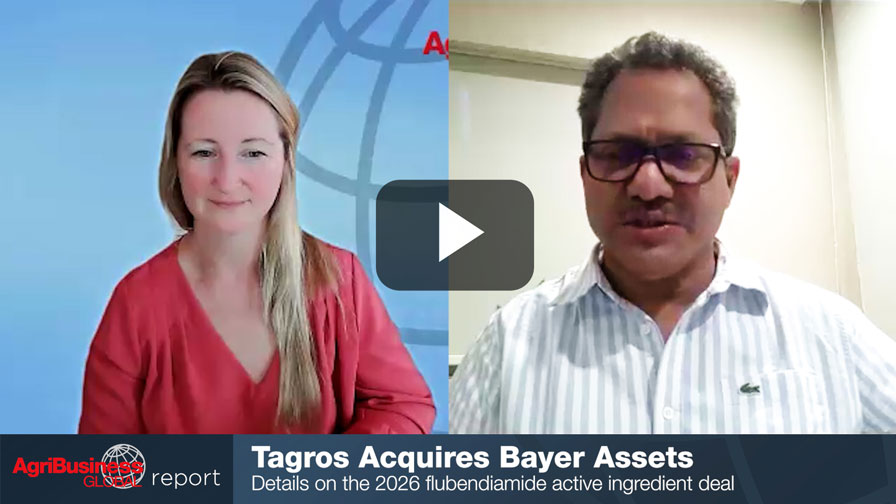
 Abhijit Bose, Executive President and Chief Operating Officer of Productos químicos Tagros India Pvt. Ltd., was a recent guest on the Informe global de agronegocios, where he shared insights into the company’s acquisition of Bayer’s flubendiamide active ingredient business — an important strategic move that underscores Tagros’ growing global ambitions in the crop protection sector.
The acquisition, which spans markets across Latin America, Europe, the Middle East, Africa, and the Asia-Pacific region, is expected to close by early March 2026. According to Bose, the transaction represents more than a portfolio expansion; it is a decisive step in strengthening Tagros’ global distribution capabilities with an established and trusted brand.
“We are quite excited about this acquisition,” Bose said. “We have signed the definitive agreement, and the transaction will be completed by early March 2026.”
Flubendiamide is a well-known diamide insecticide with a strong global presence, and Tagros’ acquisition includes Bayer’s established brand assets associated with the product. Bose emphasized that this provides immediate market access and brand recognition in regions where Tagros already maintains long-standing customer relationships.
Como parte de la transacción, Tagros adquirirá Solo y Mixture Formulations relacionadas con el ingrediente activo, junto con un conjunto integral de activos comerciales, incluidas marcas comerciales (BELT, FAME, FENOS, FENOS QUICK, BELT EXPERT y TIHAN), registros de productos y datos de registro, información de productos, conocimientos de formulación, información técnica e inventarios asociados con el negocio FLB.


“We feel that getting a globally present brand will definitely help Tagros strengthen its distribution network in all these countries,” he said. “These are globally established brands for crop science.”
Building on Decades of Global Market Presence
Tagros brings more than three decades of experience to the table, having operated in the manufacturing of technicals and formulations for over 32 years. The company is headquartered in India and operates subsidiary companies across Latin America — Brazil, Argentina, Mexico, Colombia, and Peru — as well as in Asia-Pacific markets. Many of these relationships, Bose noted, span more than 20 years.
“Tagros has already been present in all these markets, and we have had relationships with customers for more than two decades in most of them,” he said.
The acquisition aligns with Tagros’ longer-term investment in flubendiamide chemistry. Bose explained that the company began focusing on this segment several years ago, establishing backward-integrated manufacturing capabilities and initially targeting a business-to-business model before expanding into formulation registrations.
“We started manufacturing through a backward-integrated process,” he said. “Initially, we were looking at a B2B model, but we also began getting registrations for our formulations in most of these countries.”
With regulatory groundwork already in place, the addition of Bayer’s brand allows Tagros to move swiftly to market. Bose described this as a major advantage for both the company and its customers.
“This opportunity allows us to bring an established brand into our existing distribution channel and give it to our key clients,” he said. “Farmers will benefit from these well-known brands.”
Industry Consolidation and the Road Ahead
Bose also framed the deal within the broader context of mergers, acquisitions, and divestments reshaping the global agrochemical industry. While large-scale mergers — such as La adquisición de Monsanto por Bayer — defined earlier consolidation cycles, today’s environment is marked by multinationals divesting select brands as part of portfolio realignment.
“In the recent past, multinational companies have started divesting some of their brands,” Bose said. “Bayer decided to divest five global brands, and flubendiamide is one of them.”
This trend, he added, creates opportunities for regionally strong manufacturers like Tagros that combine technical expertise with distribution reach.
“It’s not only about mergers and acquisitions of companies,” Bose noted. “It’s also about acquiring global or country-specific brands if they fit into the acquiring company’s strategy.”
Looking ahead, Bose expects continued activity in brand acquisitions and joint ventures, particularly as Japanese and other multinational companies seek partnerships with regional players to access large agricultural markets.
“I think going forward, you’ll see more brand acquisitions and joint ventures in large distribution markets,” he said. “This trend will benefit the end users — farmers — by giving them access to good-quality products.”
Beyond this acquisition, Tagros is continuing to expand its global footprint. The company recently launched a wholly owned subsidiary, Arqivo, aimed at delivering value-added products and services directly to farmers in India and international markets such as Brazil, Argentina, Mexico, and South Africa.
“Our long-term plan is to establish more subsidiary companies and offer more quality products to farmers,” Bose said.
To hear more from Abhijit Bose and gain deeper insight into Tagros’ strategy and the evolving agrochemical landscape, readers are encouraged to view the full video of the Informe global de agronegocios.
¡Obtenga el boletín hoy!