O mercado cresce, as margens diminuem: a consolidação no setor de biológicos deixou de ser opcional.
The biologicals market in Latin America is going through a phase of intense momentum: growth, higher adoption, sustainability pressure, and portfolio expansion. At the same time, proposals, pipelines, and attempted differentiation narratives are multiplying.
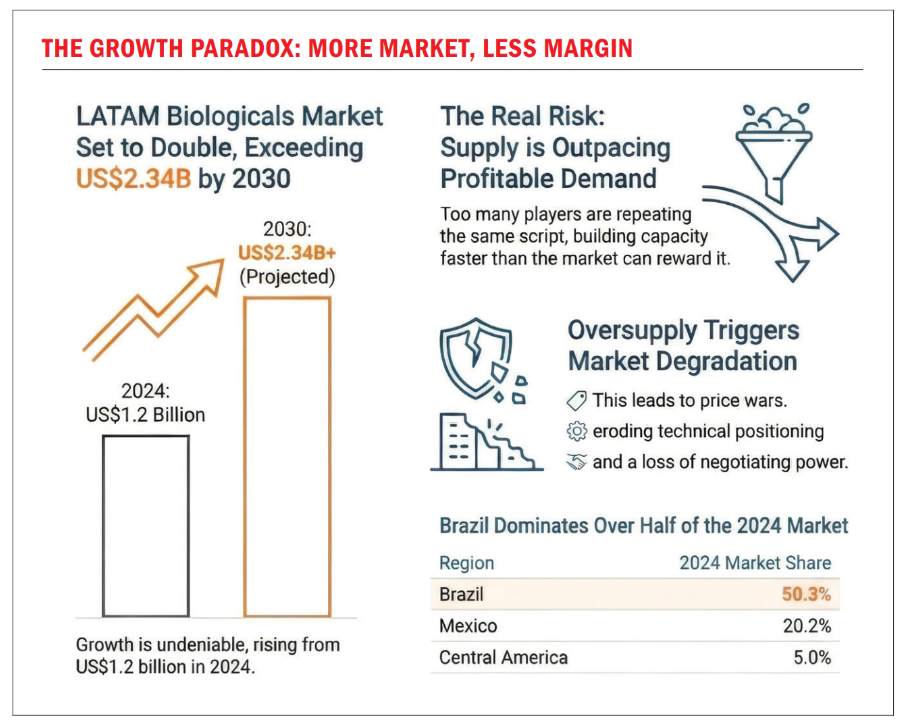
And that is where the real risk lies: When too many players repeat the same script, the market stops rewarding narratives and starts hammering away at price.
DunhamTrimmer (DT) data does not challenge the continued growth of the market — on the contrary, it confirms that its growth is foundational. What our data does force onto the table, however, is this rather uncomfortable point: Supply (capacity, portfolios, and commercial structures) are being built faster than profitable demand.
Demand is Real. Business Viability is not as Predictable.
Each one of DunhamTrimmer’s Global Market Reports reveals that LATAM is currently the fastest-growing region globally for biologicals, anchored in something very concrete: a massive agricultural base and a growing role as a global supplier of high-value fruits and vegetables, with exports to Europe, North America, and Asia.
However, for M&A, the distinction is critical: Category growth does not automatically translate into business quality or defensible multiples.


Mexico, for example, is already the second-largest biostimulant market in LATAM, at approximately U.S. $242 million in 2024, sustaining above 10% growth driven by strong adoption in export-oriented specialty crops.
Central America, as a subregion, totals around U.S. $60 million in 2024 and shows a positive trend, supported by an active retail channel and increasing participation from large corporate producers.
Up to this point, growth is undeniable. The problem is that when a market becomes overcrowded, adjustment hits margins first — and M&A follows.
Too Many Players, Too Much Capacity, Too Little Discipline
As of 2024, the LATAM region totaled U.S. $1.2 billion and is highly concentrated: Brazil represented 50.3%, Mexico 20.2%, and Central America 5.0% of regional value.
That concentration should be a little unsettling. When profitable value is concentrated into a handful of markets, there is simply not enough economic room for dozens of players to sustain similar strategies without the emergence of price pressure.
And here is a point many prefer not to say out loud: The bubble is rarely about valuations; it is usually about capacity. Productive capacity, yes, but also commercial capacity: sales teams, inventories, promises, growth pressure, and credit used to push volume.
When supply becomes oversized, the market does not self-correct; it degrades. And behavior changes quickly:
- Selling at any price becomes preferable to carrying idle capacity.
- Payment terms stretch because volume can be bought, but preference cannot.
- Technical positioning erodes because every product ends up recommended for everything.
- The channel takes control, and once the market learns to buy on price, selling on value again takes years.
This is not a crisis that erupts overnight. It is the nagging kind that quietly eats away at earnings before interest, taxes, depreciation, and amortization, month after month.
Early M&A Signals: When Growth is No Longer Enough
In any input market, M&A emerges for two reasons: strategy or urgency. In biologicals, when supply grows faster than profitable demand, the line between the two becomes blurred.
Strategic alliances and licensing deals begin to multiply. Some are excellent. Others are, in practice, a euphemism: monetizing assets because market access does not scale or working capital can no longer support growth.
Horizontal M&A also appears to buy differentiation. It sounds good. The problem is that if everyone is buying the same thing, the question becomes unavoidable: Where is the real differentiation? Buying more of the same buys time, not barriers.
Consolidation: Slow, Silent, and Unforgiving
What is coming in Latin America should not be imagined as a spectacular collapse. This will look much more like a structural adjustment: slow, selective, and made up of many small transactions that, together, redraw the landscape.
DT projects that Mexico will grow from U.S. $242 million (2024) to approximately U.S. $448.9 million by 2030, and Central America from U.S. $60 million to around U.S. $122.6 million. Total LATAM would exceed U.S. $2.34 billion by 2030.
Fonte: DunhamTrimmer
That growth is real, but growth also attracts players, and if barriers remain low, competitive pressure can grow at the same pace as the market itself.
Consolidation, then, is not a question of if it happens, but how: who buys, who sells, and who runs out of oxygen.
The Big Players Have Not Fully Entered Yet
Some regional players take comfort in the idea that multinationals are not yet all in on biologicals. That is not a strategy. It is denial.
The large players already control what matters most: distribution, farmer relationships, capital, and portfolio integration. When biologicals become a top priority at scale — whether organically or through selective acquisitions — the competitive space will shrink even further.
Competing head on with that power by offering similar products is not competition. It is volunteering to lose.
If your plan depends on large players staying distracted, you do not have a plan. You have hope.
Where Real M&A Value Still Exists
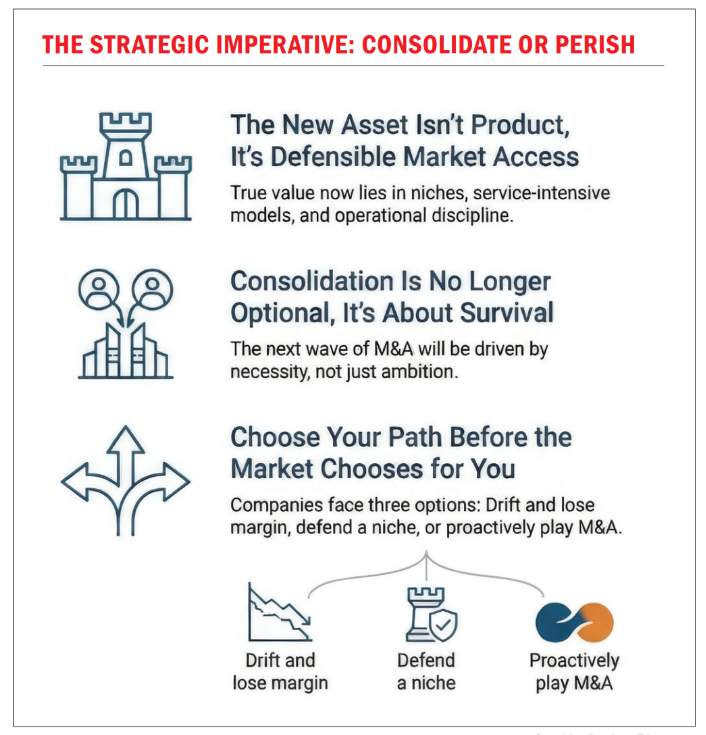
In biologicals, the product is no longer the asset. It is the entry ticket. The real asset is market access:
- Defensible niches (crops, regions, production models) that are relevant at a regional scale and unattractive for mass strategies.
- Service-intensive models (agronomic results + execution + recommendation) that take you out of price wars.
- Proprietary market access (unique relationships with channels, cooperatives, or service integration).
- Operational and financial discipline (margins, collection quality, working capital management).
If the only buy-sell argument is “we have a good product,” the multiple will be whatever the buyer decides, and it will rarely be generous.
Choose Now, or the Market will Choose for You
Markets are growing. That is a fact. DT’s research and analysis show it clearly, but growth is not an insurance policy for profitability — it simply amplifies the gap between those who capture value and those who only move volume.
Fonte: DunhamTrimmer
From here on, there are decisions that cannot be postponed:
- Decide on your path: Not deciding (drifting) means continuing to push volume with a generic proposition until the market sets your price. This is the fastest way to lose margin — and negotiating power.
- Locking into a defensible, profitable niche: Step away from battles you cannot win and build depth (crop/region/system) with technical service and true repeat business.
- Playing M&A with timing: Be a consolidator if you have the muscle or prepare to be acquired with dignity — backed by a solid thesis and a defensible confidential information memorandum — before adjustment forces you to negotiate from weakness.
The worst scenario is waiting for the market to grow enough so that everyone wins. The market can grow — and still destroy value for most players.
Remember that the market grows, and value does not. Value is captured.
Receba a Newsletter hoje mesmo!