Rovensa Next在巴西新建试点发酵工厂,增强其全球创新能力

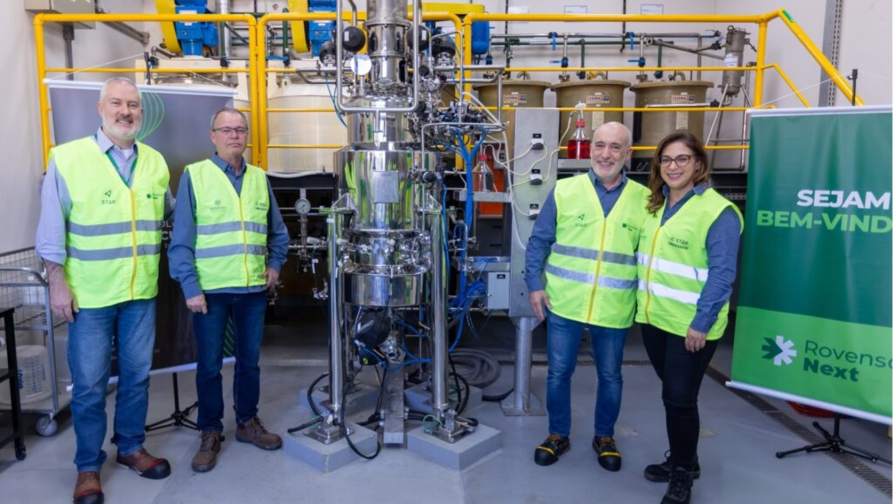
Victor Sonzogno, Head of Brazil; Odacir Lameu, R&D Coordinator; José Nolasco, Global Head of R&D Bionutrition; and Johana Perez, Global R&D Manager, during the inauguration of Rovensa Next’s new pilot fermentation plant in Brazil.
Rovensa Next, the global leader in biosolutions for agriculture, has opened a new pilot fermentation plant in Brazil, strengthening its global R&D and scale-up capabilities in microbial biosolutions. The facility creates an intermediate step between laboratory research and full industrial production, reducing development risks and accelerating the launch of new bio-inputs.
Now fully operational after its completion in July 2025, the pilot plant supports product design projects for Brazil and international markets, and plays a central role in Rovensa Next’s innovation pipeline, particularly for complex microbial processes that require precise control at scale.
Located at the Monte Mor industrial fermentation site, it works in close connection with the company’s Global Research and Innovation Center for Biosolutions in Hortolândia, where teams conduct microorganism research, bench-scale fermentation and formulation development for agricultural biosolutions.
Together, the two sites form a single ecosystem in Brazil that supports microbial innovation from early research to industrial scale, driving the creation of next‑generation microbial-based biosolutions for global markets.
SCALING MICROBIAL PROCESSES WITH INDUSTRIAL ACCURACY
The pilot plant operates using the same utilities as Monte Mor’s production facility. It offers a working volume of 100 liters and a capacity of 150 liters, increasing relevant fermentation volume by up to 20 times compared with laboratory systems.
Until now, microorganisms moved directly from laboratory bioreactors of up to seven liters to industrial tanks exceeding 3,000 liters. The new pilot bioreactor, with industrial-equivalent geometry, allows R&D teams to simulate production conditions with far greater accuracy.
“This facility is a real turning point in how we move from research to industrial production,” said Johana Perez, Global R&D Manager at Rovensa Next. “We now have much tighter control over formulations, cultivation parameters and production strategies at representative scales, which allows us to validate new bio-inputs more quickly and with greater confidence.”
TECHNOLOGY DESIGNED TO MIRROR INDUSTRIAL PRODUCTION
The bioreactor is equipped with advanced monitoring and control systems for pH, oxygen, temperature, foam, and pressure. The industrial team was directly involved in its design and customization, ensuring that equipment, sensors, and sterilization procedures match those used in the manufacturing plant.
Microbial bioprocesses do not scale linearly. As volumes increase, parameters such as oxygen transfer, nutrient availability, and productivity can change, directly affecting yield and performance. The pilot scale enables these parameters to be adjusted and validated under conditions that closely replicate industrial operations.
For José Nolasco, Global Head of R&D Bionutrition, the timing is critical. “Global demand for healthy food is growing fast, while agriculture faces increasing climate and sustainability constraints,” he said. “Technologies developed in Brazil will play a central role in delivering the next generation of biosolutions.”
The system also enables teams to validate fermentation timelines, assess industry-relevant inputs, and estimate operational costs earlier, reducing risk and waste before full-scale manufacturing. Beyond improving data quality, the pilot facility adds flexibility to the R&D process and was commissioned following rigorous sterility, sealing, and fermentation tests, ensuring readiness for advanced development work.
PREPARING FOR THE NEXT GENERATION OF BIOSOLUTIONS
The fermentation plant supports the development and scale-up of both new microorganism-based biosolutions and those already part of Rovensa Next’s portfolio. These include products that improve nutrient-use efficiency, support tolerance to abiotic stress, and enable biocontrol applications, areas where biological solutions increasingly complement or replace conventional inputs.
Current solutions include Phos’Up, which improves phosphorus availability in the soil, and Azzofix, a microbial seed treatment that enhances nitrogen-use efficiency in crops. The portfolio also includes Wiibio, a Bacillus-based biofertilizer focused on soil regeneration, and Biimore, a biostimulant designed to deliver high performance at ultra-low doses during key crop development stages.
Bringing these new solutions from the laboratory to industrial production often requires specific conditions that differ from those used for existing products. To address this, the pilot plant is designed to evolve, with future equipment such as centrifuges, filters, and spray dryers to achieve efficient scale-up and faster deployment.
“Internally, this gives us more efficiency, quality and agility across our processes,” said Odacir Lameu, R&D Coordinator and head of the pilot plant. “For growers, it means faster and more reliable responses to their needs for innovative bio-inputs,” he added.
Ultimately, the pilot plant reinforces Rovensa Next’s R&D and innovation capabilities. By bridging laboratory science with industrial production, it accelerates innovation cycles and supports the delivery of high-quality biosolutions at scale, contributing to a more sustainable agriculture.