Brazil, Argentina, Mexico: What’s Driving Crop Protection Markets in 2026
 10 March 2026
 This article will outline the crop protection markets in certain countries in Central and South America, namely Argentina, Brazil, and Mexico, examining the current situation as well as the key future trends expected to influence market development in the coming years.
Brazil
Key Factors
There’s been generally favorable weather for planting and early crop development. However, some regions were impacted by recent drought following irregular and poorly distributed rainfall in November. Brazil crop areas are expected to be up by 3.0% in 2025/26. Soybean area is expected to rise again, up by 3.4%. Maize area is expected to be up by 4.1%. Crop production is expected to rise by 0.6%.
Key Policy Developments
Brazil announced the allocation of BRL 67 million (USD 12.6 million) to support the release and marketing of up to 250,000 tonnes of wheat in the states of Rio Grande do Sul and Paraná.
Market Progress 2025, Outlook 2026
In Brazil, the total planted area is expected to increase by 3.0% in 2025/26 over the previous year, amounting to 84.2 million hectares. Within this, greater areas are forecast for most tracked crops year-over-year, with the exception of rice (-8.1%) and beans (-2.3%). Total crop production in the 2025/26 season is estimated to reach 354.4 million tonnes, a rise of 0.6% over the previous year. Within this, greater production is projected for soybean (+3.3%) and “other” crops (+4.2%). However, declines are expected for maize (-1.5%), beans (-1.8%), rice (-12.4%), and cotton (-2.9%), with wheat production forecast to remain in line with the previous year.
Soybean planting is progressing well, with conditions generally favorable, although irregular rainfall and weather events in southern regions, such as strong winds and hail, are a concern. For maize, the planting of the first crop is progressing, with the area up by 7.2% from the prior year to exceed 4 million hectares. Maize production in Brazil is benefiting from strong growth in the ethanol sector in the country, with output expected to double in the coming years, while production of ethanol from sugarcane is expected to remain steady.


Embrapa, Brazil’s agricultural research agency, has developed a new technology to detect fall armyworm (Spodoptera frugiperda) in maize crops. The technology uses sensors and artificial intelligence to analyze images and identify caterpillars on both the leaves and ears of maize plants. This system of detection has the potential to be integrated with agricultural implements and equipment such as drones in the future.
Argentina
Key Factors
Wheat area is expected to be up by 6.2% in 2025/26, but barley down by 14.7%. Maize area is up by 12.0%. Alerts were issued over early and intense infestations of fall armyworm in some regions. Argentina permanently lowered grain export taxes.
Key Policy Developments
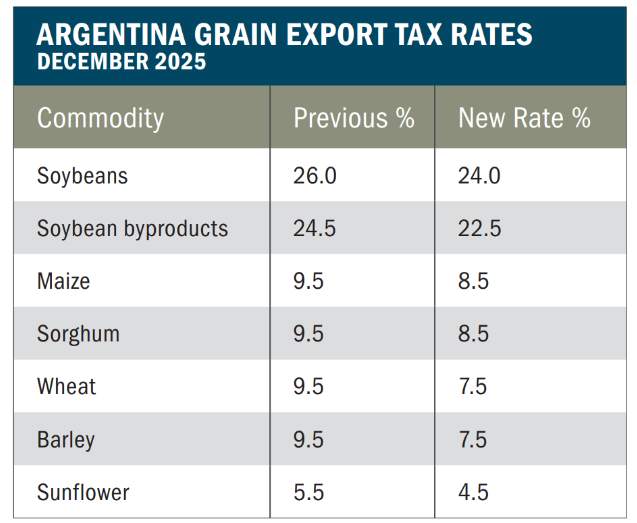
Argentina announced it would temporarily reduce the mandatory share of biodiesel in diesel fuel, from 7.5% to 7.0%. The country also approved a 6.2% increase in the minimum price of biodiesel for mandatory blending with diesel. The country also implemented new permanent reductions in export taxes for grain products and byproducts. This follows the permanent lowering of export taxes for several major agricultural products earlier in the year. The lower tax rates will remain in place for the duration of Argentina’s current administration.
Market Progress 2025, Outlook 2026
The Argentinian Ministry of Agriculture’s latest forecasts for the planted areas of key crops in the 2025/26 season suggest area expansions for wheat (+6.2%), sunflower (+16.7%), and maize (+12.0%), while the areas under barley (-14.7%), soybean (-3.3%), sorghum (-10.0%), rice (-17.4%), peanut (-15.1%), and cotton (-13.0%) are expected to decline.
The development of the first maize crop, the most significant maize crop in Argentina, is benefiting from good soil moisture levels and favorable conditions. The Argentinian research institute INTA Reconquista issued an alert regarding unusually early and intense infestations of fall armyworm in maize crops in northern Santa Fe. This atypical outbreak has been attributed to environmental conditions, poor refuge compliance, and suboptimal pest management.
For soybean, planting is continuing for the early-planted crop. However, excessively wet conditions in some regions are hampering field access.
Argentina has implemented new permanent reductions in export taxes for grain products and byproducts. This follows the permanent lowering of export taxes for several major agricultural products earlier this year. These lower tax rates, outlined in the table to the left, will remain in place for the duration of Argentina’s current administration.
Argentina recently exported its first shipment of wheat to China, following the inclusion of Argentinian companies in China’s list of approved exporters in 2024. In the 2025/26 marketing year, it is estimated that Argentina will be the seventh leading exporter of wheat, shipping approximately 14 million tonnes.
Mexico
Key Factors
The harvest of the main maize crop is being impacted by very wet conditions.
Key Policy Developments
Mexico announced it would guarantee a price of MXN 6,050 (USD 329) per tonne for white maize in the states of Guanajuato, Jalisco, and Michoacán.
Market Progress 2025, Outlook 2026
The economy in Mexico is among the largest in the Latin America region, behind only Brazil, and more than 90% of overall trade is through free trade agreements. These agreements are integral to the country’s agriculture sector, although the drawback of this highly industrialized economy is that agriculture in the country is affected by low-cost imports from its trading partners, who generally place more of a focus on the production of row crops.
The increasing focus on fruit and vegetable production has benefited the crop protection market in recent years, with the expansion of this sector expected to continue in the coming years, although water scarcity is an increasingly severe challenge in Mexico, exerting significant pressure on the agricultural sector.
The high number of biological crop protection products that are being introduced is expected to drive growth, with this sector in line for rapid expansion, ahead of the growth rates expected for conventional crop protection products.
The value of the crop protection market in Mexico is expected to increase by an average of 4.0% per annum to reach $1,483 million in 2029. However, this growth could be tempered if the country is afflicted by any prolonged dry spells, as has been experienced in some recent years. Any further advancements toward improving irrigation in the country would clearly mitigate the potential negative impacts of dry conditions.
CENTRAL & SOUTH AMERICA
Looking ahead to 2026
For Central and South America in 2024/25, while agrochemical prices and commodity prices remained low by historical standards, higher areas of key crops in Brazil and Argentina and generally improved weather conditions were positives for market development. In addition, continued growth in other countries in the region, notably Chile, Colombia, and Peru, benefited market performance, driven by high demand for fruit and vegetable exports in particular.
Despite this, mainly due to continued pricing and currency impacts, AgbioInvestor’s preliminary estimates for the value of the crop protection market in Central and South America in 2025 suggested a decline of 7.5% to $21,502 million in nominal terms. In constant currency terms, this equates to an increase of 2.0%.
Stabilization in agrochemical and commodity pricing is a positive, while weather conditions are expected to be more positive, despite some concerns over early season dryness in parts of Brazil. Pest pressure is expected to be relatively high, while expectations for higher areas of key crops in Brazil and Argentina are significant positive drivers for the market moving forward. Brazil is also continuing to benefit from strong export demand from China, with the country now substantially ramping up its imports of Brazilian sorghum, in addition to continuing high demand for maize and soybean, including domestically where maize-based ethanol is ramping up significantly. There are also expectations that growth will continue in other countries in the region where fruit and vegetable production takes precedence over row crops.
Novel product introductions can also be expected to benefit the crop protection market in the coming year, with notable introductions including Bayer’s insecticide Plenexos (spidoxamat) in Colombia, representing the first spidoxamat-based product to be commercialized globally; FMC’s cereal fungicide Fidresa (fluindapyr/prothioconazole) in Argentina for use on wheat and barley; Syngenta’s fungicide/nematicide seed treatment Victrato (cyclobutrifluram) in Brazil; FMC’s cereal fungicide Fidresa (fluindapyr/prothioconazole) in Argentina; and CropChem’s acaricide/insecticide Perseus Duo (spirodiclofen/abamectin) in Brazil for use on coffee and citrus.
Get The Newsletter Today!