The Diversification Dilemma in Agribusiness: Lessons From Sebastian Bachem
 10 November 2025
 At the 2025 AgriBusiness Global Trade Summit, Sebastian Bachem, Board Advisor at Accumont, delivered a compelling presentation titled “Diversified Portfolios: Strategy, Regulation & the Road Ahead.” Drawing on nearly four decades of experience in crop protection, Bachem explored the strategic, regulatory, and technological dimensions of diversification in agriculture, particularly with biological products.
The Diversification Dilemma
“I’ve spent nearly 40 years in the crop protection industry,” Bachem began. “Twenty-five of those years were with Bayer Crop Science in operational roles, followed by strategic work at BASF focusing on specialty crops. That experience led me to become deeply involved in biocontrol and innovation, particularly in high-value specialty crops where innovation often begins.”
Now a partner at Accumont, Bachem works with a network of seasoned advisors to guide companies through investment and portfolio development. He highlighted the “diversification dilemma,” where agtech investments in biocontrol, biopesticides, digital tools, and genetics have not always yielded expected returns. “Some companies have spent billions, and many of those investments haven’t delivered the expected results,” he said.
Despite this, Bachem remains optimistic. “Diversification for its own sake doesn’t make sense,” he cautioned. “It must be guided by a clear strategy and a solid understanding of the value it brings.” With over $50 billion invested in agtech in the past five years, the challenge is ensuring these innovations reach farmers and the supply chain to deliver real benefits.
Regulation and Innovation
“We’re operating in an exceptionally tumultuous environment,” Bachem noted. Regulatory hurdles, especially in Europe, are a major barrier. “In Europe, it still takes 5 to 10 years and more than $300 million investment to bring a product to market.”
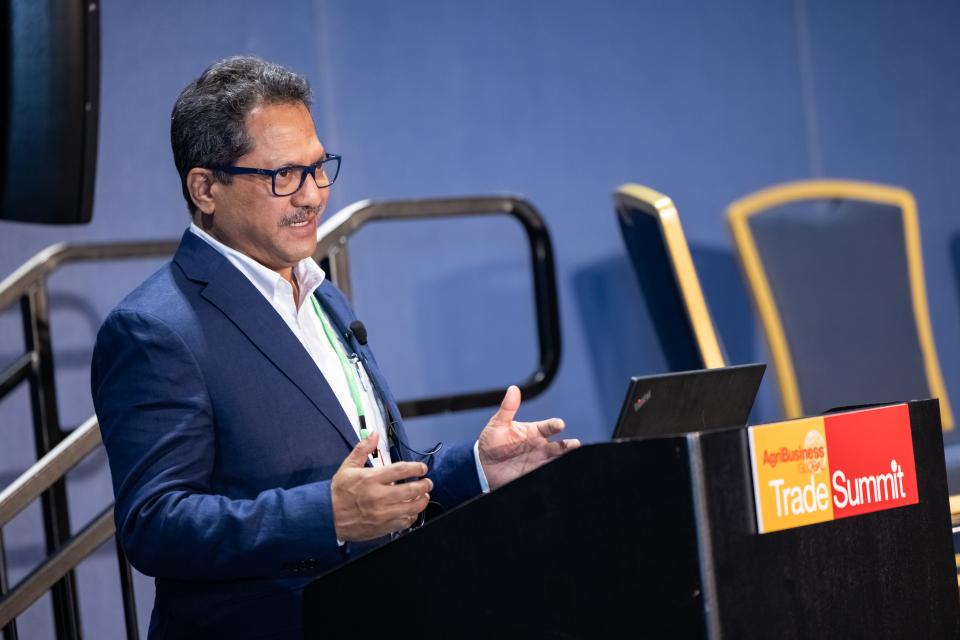



Yet, there are signs of progress. The EU Sustainable Use Regulation has been revised, and new genomic techniques (NGTs) offer promise. “NGT1 allows companies to make precise DNA edits, speeding up development significantly,” he explained.
To navigate this landscape, Accumont uses a “quartile view” to assess technologies based on performance and leadership. Bachem shared examples like Lithos mineral-based pheromone dispensers for field crops, SugaROX’s single-molecule biostimulants, and Kilter’s precision application tools. “This kind of innovation is crucial for sustainable agriculture,” he said.
Technology and Strategic Fit
“AI is driving a revolution in agriculture,” Bachem said. “A machine learning algorithm designed to identify a disease can be adapted to detect a pest.” This adaptability is key to scaling biocontrol solutions.
He contrasted small wine growers in Germany, who manage 10 to 20 hectares and know every plant intimately, with large-scale farms where such oversight isn’t feasible. “Technology becomes critical. It enables scalable, softer approaches to disease management.”
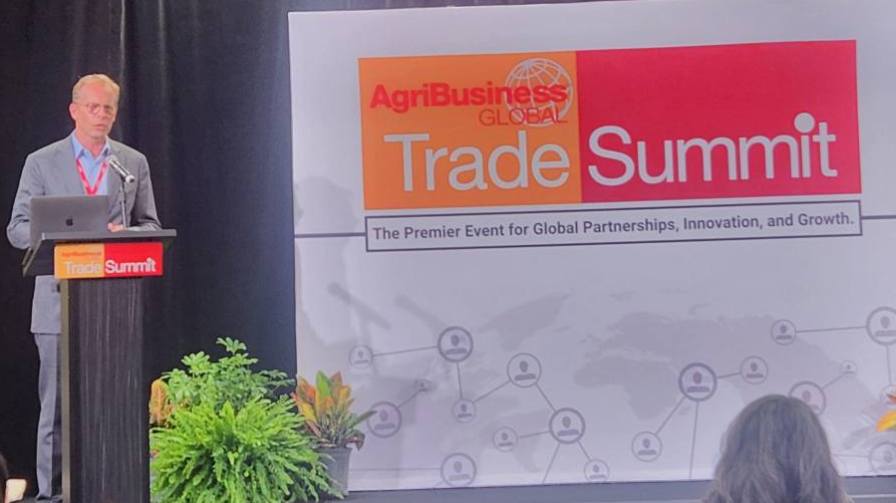
Accumont Board Advisor addresses attendees at the 2025 AgriBusiness Global Trade Summit.
Bachem warned against assuming that acquiring a product guarantees success. “You think buying a company for $1.2 billion will solve everything, but it’s far more complex.” Farmers need to understand how a product works and its benefits. Without trials and a deep understanding of the product, companies risk failure. “You need partners willing to start small, build knowledge, and grow the business gradually.”
Partnerships and Long-Term Vision
Another common mistake is misjudging farmers’ willingness to pay. “If they don’t see a clear benefit or ROI, they won’t adopt the technology,” Bachem said. A clear value proposition is essential.
Digital tools and AI can support diversification, but companies must choose the right partners. “You don’t have to do it all yourself,” he emphasized. “Partnering is a huge factor.”
He also stressed the importance of patience. “Time-to-market in crop protection is long. You won’t see massive returns in two years. You need stamina, patience, and a smart regulatory strategy.”
To succeed, companies must plan carefully. “If you get most of the critical elements right, even 80% to 90%, you’ll likely succeed,” Bachem concluded. “Be agile, seek partnerships, and understand your organizations strengths. Diversification is essential, but it must be done wisely.”
Get The Newsletter Today!