


New Sun Unveils SIGLUXE Microalgal Peptides, Opening a New Pathway for Global Plant Health
Plant viral diseases are among the most challenging biotic stresses in global agriculture. FAO and IRRI studies show that viral infections can cause 10–30% yield losses in many crops, with even greater impact on high-value vegetables and solanaceous crops. As insect-borne transmission accelerates and mixed-virus infections become more common, traditional chemical protection and resistant varieties are increasingly insufficient.
Enhancing the plant’s own defense mechanisms—reducing infection risk and supporting physiological recovery—has therefore become a major focus in modern plant health management worldwide.
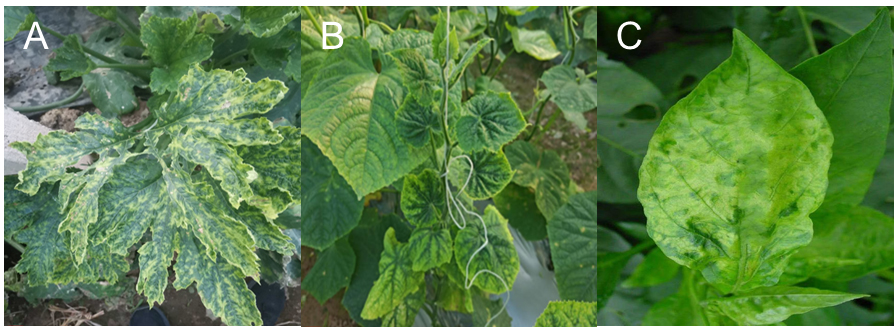
Figure 1. Typical symptoms caused by viral infection in crops, including mosaic and leaf curling. A. Zucchini B. Cucumber C. Pepper
International monitoring data from leading organizations such as CABI, EPPO, FAO, CIMMYT, and IITA show that viral diseases continue to expand across continents. Tomato yellow leaf curl virus has established itself in Asia, Europe, and the Americas; maize lethal necrosis and cassava mosaic disease continue to challenge food security in Africa; and in China, cucurbit and vegetable crops suffer from a long list of viruses year-round, including CCYV, CGMMV, CMV, MYSV, PRSV, and TMV. The resulting symptoms—leaf mosaic, deformation, curling, and bitter or malformed fruit—can make entire harvests commercially useless. The global need for safer and more effective preventive technologies has never been stronger.
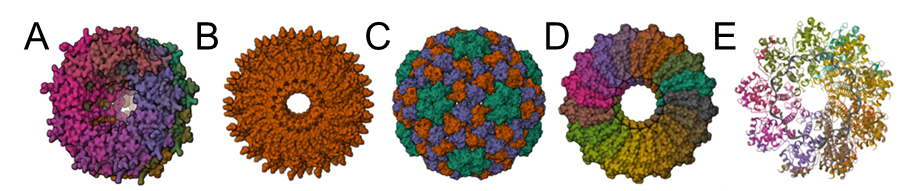
Figure 2. 3D structural information of major plant viruses: A. TuMV B. CGMMV C. CMV D. TMV E. PVX
Synthetic Biology Innovation Enables a New Production Model
Against this backdrop, New Sun has taken a new step forward with the development of SIGLUXE, a microalgal peptide complex produced through synthetic biology–guided molecular design. Microalgae such as Chlorella vulgaris are known for their rich content of peptides, polysaccharides, nucleotides, and unsaturated fatty acids, and they have long been studied as a promising source of biologically active molecules. In recent years, an increasing number of international studies have confirmed the potential of microalgal peptides and polysaccharide fragments to enhance plant immunity, improve stress tolerance, and support overall physiological balance.
New Sun’s AMCC Technology Creates a Full Defense Cycle—from Inactivation to Recovery
Unlike conventional chemical control approaches, New Sun’s AMCC active-molecule technology establishes a multidimensional plant-health loop—from nutritional reinforcement and defense-hormone mobilization to active immune priming—significantly enhancing preventive performance.
Natural peptide chains interfere with viral coat-protein interactions and host receptor recognition, reducing viral activity and limiting cell-to-cell movement, thereby slowing the progression of infection.
The technology upregulates host defense-related genes and signaling pathways (SA/JA/ET), strengthening cell-wall barriers and antioxidant systems to increase the plant’s resistance to viral penetration.
Clusters of natural bioactive peptides stimulate the production of defensive phytohormones and activate the plant’s innate immune memory, generating a “warning–response” state that enhances secondary-metabolite synthesis and provides broad-spectrum protection potential.
Rich in hydrolyzed amino acids and microalgal organic matter, the formulation rapidly replenishes nutrients and supports metabolic and structural recovery in virus-affected plants.
Derived from renewable biological resources and produced through green, low-impact processes, this technology aligns with the principles of regenerative agriculture and low-carbon plant-health management.
Proven Stable Performance Across Regions with Excellent On-Farm Compatibility
Across multi-location trials, SIGLUXE demonstrated consistent performance in nutrient reinforcement and plant health promotion in crops such as cucumber, zucchini, pepper, and tomato:
- Preventive use: Healthy new-leaf ratio increased by 50–80% (verified by third-party institutions).
- Post-infection support: Deformed leaf rates declined significantly; SPAD values, leaf area, and stem thickness improved.
- Overall growth: More coordinated vegetative development, improved fruit set, and higher marketable yield.
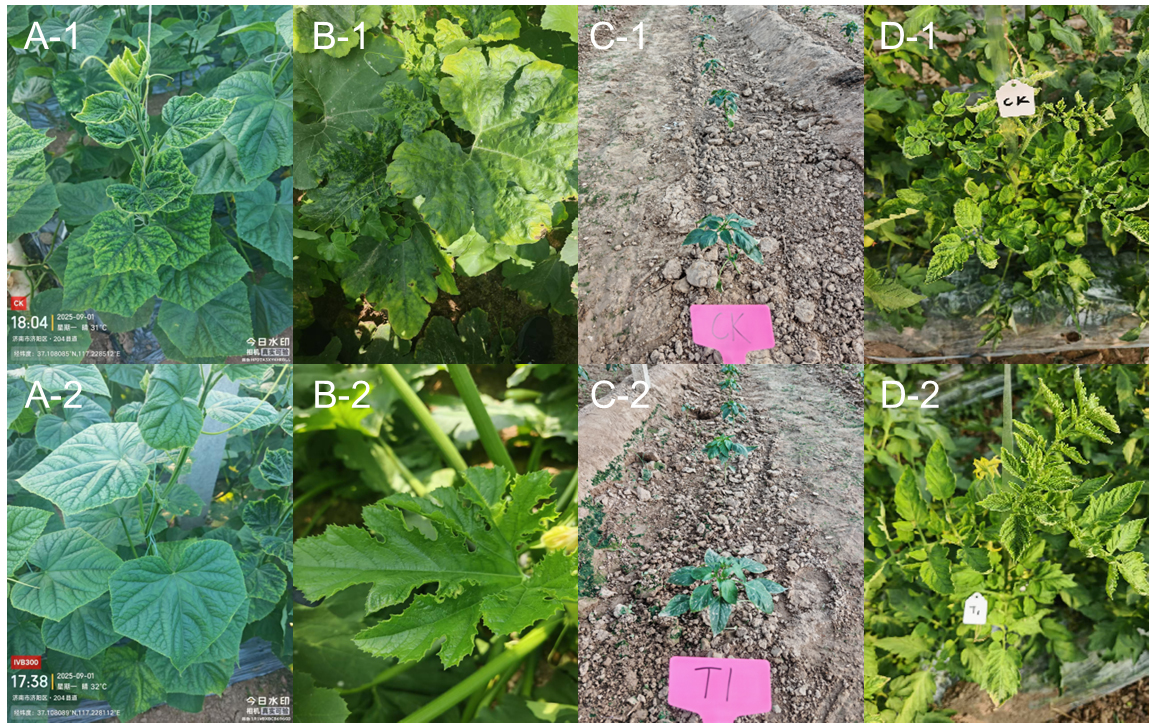
Figure3. Field performance of SIGLUXE A-1, A-2: Cucumber (water control vs. SIGLUXE treatment) B-1, B-2: Zucchini (water control vs. SIGLUXE treatment) C-1, C-2: Pepper (water control vs. SIGLUXE treatment) D-1, D-2: Tomato (water control vs. SIGLUXE treatment)
One of the reasons SIGLUXE has been well received by growers is its ease of use. It can be applied through foliar spraying or fertigation and blends seamlessly with organic fertilizers, water-soluble nutrients, plant growth regulators, and both biological and chemical crop protection products. No additional equipment or technical steps are required; farmers can integrate it into existing management programs without any operational barriers.
Better preventive efficacy, safer growing conditions, and lower input costs
For seedling-stage applications, SIGLUXE is used at 30–40 mL/mu, and during the reproductive stage at 60–80 mL/mu; fertigation rates are 500–1000 mL/mu. A full preventive program typically includes 3–4 foliar sprays plus one fertigation treatment. Its preventive performance is significantly superior to commonly used agent. Compared with mixed formulations containing oligosaccharides and protein complexes, SIGLUXE provides better performance at a lower cost. The application of AMCC technology effectively activates the crop’s innate immune regulatory capacity while avoiding pesticide-residue and related environmental risks. It can be easily integrated into combined strategies that target vector suppression, virus prevention, and plant growth promotion. By reducing field replanting losses, lowering spray frequency, and minimizing crop damage, it improves the overall economic return for growers.
New Sun is committed to delivering leading integrated biological protection solutions for global agriculture. SIGLUXE Microalgal Peptides represent an innovation built from first principles. As global agriculture increasingly demands solutions that are both efficient and sustainable, this microalgal peptide technology provides a new, practical option for the green prevention of viral diseases in high-value crops worldwide.