Perspectivas de la industria agroquímica china para 2027
 23 de noviembre de 2026
Here are several key takeaways regarding the China agrochemical industry outlook for 2027.
- The China agrochemical industry has moved from the cyclical trough into “a mild bottom-level recovery with sharp structural divergence.” The agrochemical price center is still far below the 2021 peak: In November 2026, the median price of 131 comparable technical-grade actives was still 51.4% below its 2020-2023 peak, and 51.9% of actives were more than 50% below peak.
- The binding constraint in the external environment is not end demand but channel cash/credit and regulatory barriers: 23% of Brazil’s farm loan book is classified as troubled, North American channels have shifted to just-in-time buying, and U.S. antidumping/countervailing duty (AD/CVD) proceedings on Chinese glifosato and the EU “technical zero” MRL policy are advancing in parallel.
- China domestic demand has plateaued; agrochemical industry growth depends almost entirely on exports, and exports are shifting from volume growth to value growth — formulation export value exceeded technical material for the first time in 2024 (54.12%), and the January to September 2026 average export unit value rose 4.7% year on year.
- The 15th Five-Year Plan is a “closing” plan: It shuts the low-level incremental capacity channel and revalues existing registration/capacity assets. The Concentration Ratio of Top 10 (CR10) rose from 34% in 2024 to 45% in 2025; exceeding 60% by the end of the plan period is highly likely. It is projected that by the end of China’s 15th Five-Year Plan period for pesticides, the CR10 of China’s crop protection industry will exceed 60%.
- The determinants of corporate success have shifted from “capacity + cost” to “registration assets + global channels + compliance/data capability + FX and credit management”: The 24 China listed agrochemical companies grew 9 million 2026 revenue by 2.26% while recurring net profit fell 8.02%; every high-ROE company relies on structure, barriers, or internationalization rather than China agrochemical industry (Beta was originally a regression coefficient in the CAPM model, measuring the sensitivity of an individual stock’s return to movements in the overall market).
- Capacity investment in 2026 is “product upgrading,” not “chasing price rises”: It is concentrated in off-patent/new-chemistry actives priced at 16.8-80.0, while mature commodity actives (glyphosate, 2,4-D, atrazine) show an “investment vacuum”; 46% of projects have not broken ground, and only 13% have formed output.
- There are five decisive questions for 2027: whether price rises convert into profit; the U.S. AD/CVD and Brazilian 35% tariff rulings; the final EU Omnibus X text; the RMB path; and the timing of concentrated new-capacity releases.
Global Crop Protect Market Environment: Demand Is There; Cash and Rules Are Not
The global crop protection market is valued at approximately USD 75 billion, with an annual value growth rate of around 2%. While global agricultural demand for crop protection products has bottomed out, market prices have not risen alongside the recovery in demand. In 2025, sales volumes across the global crop protection market edged higher, yet pricing remained the sole drag on performance. Generic crop protection products continue to capture core distribution channels across key markets at the expense of branded products from originator companies. By 2026, generics account for more than 80% of the global crop protection market value, compared to just 53%-55% in 2023. Meanwhile, Chinese-made crop protection products have become the pricing benchmark for global supply. China holds 69%-87% of production capacity for many key technical materials and intermediates. Although China’s anti-commoditization policies, the removal of export tax rebates for selected TC products, and rising energy costs have jointly lifted TC prices in 2026, price pass-through from Chinese suppliers to distribution channels typically lags by one to two selling seasons.
A closer look at end-market segments reveals distinct characteristics. The North American pesticide market features lean inventories, short lead times, just-in-time procurement, and widespread price declines for post-patent core actives. In Europe, tightening maximum residue limit (MRL) standards are constraining pesticide sales. Demand persists in Brazil, yet distributors’ capacity to carry receivables is deteriorating.
As nations shield domestic industries amid economic volatility, shifting trade policies and green regulatory frameworks have emerged as critical variables shaping the global crop protection market. Examples include the U.S. antidumping and countervailing duty investigations targeting Chinese glifosato, y Sindiveg’s proposal in Brazil to raise import tariffs to 35% for six formulation tariff lines.
The EU’s proposal to impose a zero-residue requirement for unapproved high-risk actives will indirectly restrict the use of agrochemical inputs in agricultural exporting nations. Even pesticides legally applied in Brazil may be abandoned by growers if the corresponding MRL for that active is lowered for crops exported to the EU, which may result in lost orders for Chinese suppliers operating in third-country markets. In short, policy uncertainty is on the rise.
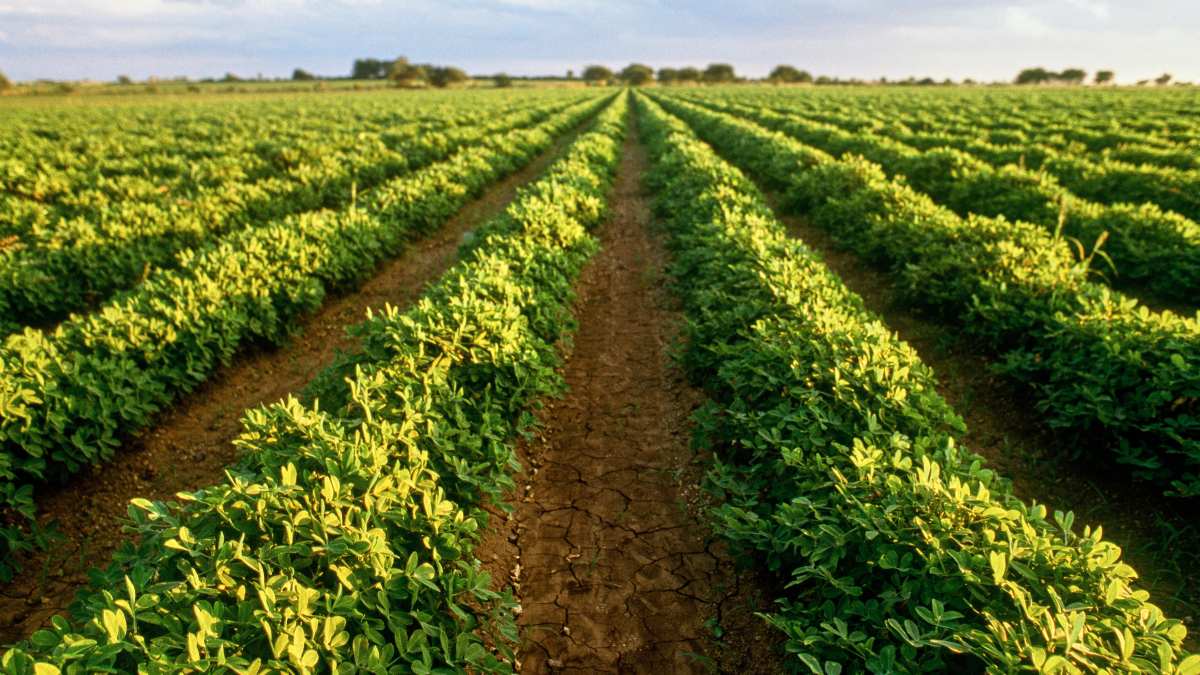


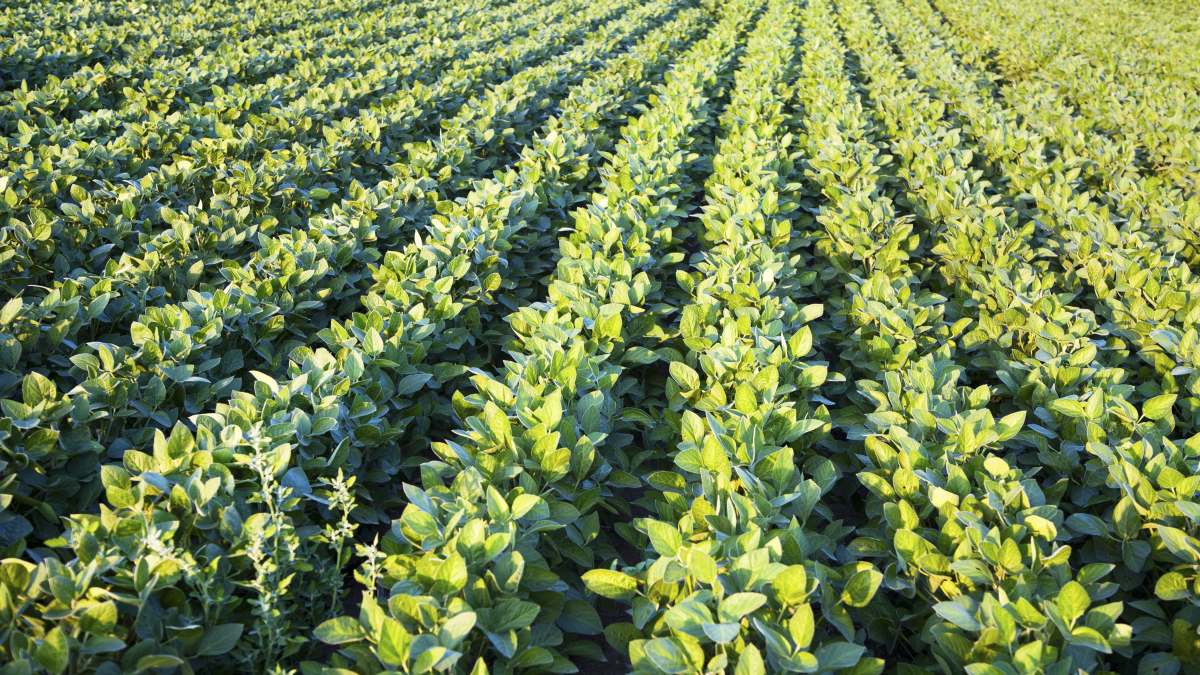
Among the drivers reshaping the crop protection landscape, one trend merits close attention: Seeds and traits developed by multinational firms are displacing part of chemical pesticide usage. For instance, transgenic traits in Brazil have cut pesticide application intensity by 35% for soybeans and 27.5% for cotton. BASF’s nematode-resistant transgenic soybean is slated for commercial launch in Brazil and the U.S. in 2028, posing a direct threat to nematicide markets. These examples illustrate the trend clearly.
While risks for the global crop protection market are already emerging in 2027, meaningful opportunities still exist. First, Chinese generic crop protection products retain compelling cost-performance advantages as alternatives to branded offerings from multinational corporations. In a downward economic cycle, once overseas farmers come under income pressure, the global market share of Chinese-formulated products will keep rising, with sustained disruption particularly in high-end crop protection segments. Second, differentiated products still offer room for growth. The shift from single-active formulations to co-formulations and multicomponent blends is an inevitable trend. Among multinational players, Corteva y Nutrien have already reflected their differentiated positioning in financial statements.
Corteva’s new-product volumes rose 20% in Q3 of 26 and 14% in the first nine months of 2026; Nutrien’s own-brand crop protection gross profit reached U.S. $552 million in the first nine months of 2026 (~+20%, 41% of the category). So, it will be easily concluded that “products that can be differentiated grow; commodity single-active formulations bleed in the price war.” Furthermore, biocontrol products still present an opportunity window. The EU Omnibus X proposes a fast track and provisional authorizations for biocontrol substances; under Brazil’s Law 15,070/2024, bioinputs have statutory priority and a “reference specification” fast track (strain-level dossiers and genomic identification required).
For Chinese enterprises, the most important growth driver lies in the global rollout of China’s proprietary patented compounds. For example, cyproflanilide (IRAC Group 30), the innovative active ingredient developed by CAC Nantong, will reach 40 overseas countries following its partnership with UPL. BASF – Deyan Innovation is focused on introducing new active ingredients into the Chinese market. If we tally newly registered compounds worldwide, China accounts for more than 60% of all innovative pesticide active ingredients. Between 2027 and 2032, we are likely to witness a growing number of Chinese-originated innovative products entering global markets.
China Domestic Market: Volume Has Peaked; Growth Comes from Exports and Mix
As Asia’s largest single crop protection market, China is a major focus for both multinational corporations and domestic Chinese players. Nevertheless, diverging trends are emerging across three dimensions of China’s pesticide sector: consumption, production, and exports. China’s volume of chemical pesticide usage (active ingredient basis) stands at approximately 240,000 tonnes. During the 14th Five-Year Plan period, the annual average consumption was 245,000 tonnes, representing a 9.2% decline versus the 13th Five-Year Plan period. Pesticide application intensity reached 114 grams per mu, down from 130 grams per mu in 2020, with China’s global ranking dropping from 73rd to 96th. By contrast, China’s pesticide output totals 2.5462 million tonnes, of which 2.3034 million tonnes are exported to more than 190 countries. Judging by application rates and field consumption volumes, domestic demand in China has hit a ceiling.
Overcapacity and product homogenization remain contentious issues and will act as long-term constraints for China’s pesticide industry. China agrochemical capacity was about 3.45 Mt in 2024 with utilization of only 66% (nearly 10 points below the national industrial average); 53,000 registered products cover 754 active ingredients — more than 70 products per active on average; about 1,798 above-scale enterprises.
Nevertheless, upgrading the export mix has become an inevitable strategic path for China’s pesticide industry amid these constraints. In 2024, formulation export value surpassed technical material exports for the first time, accounting for 54.12% of total pesticide export revenue. From January to September 2026, exports under HS code 3808 reached USD 7.839 billion (+9.6%) in value and 2.6205 million tonnes (+4.7%) in volume. That said, China’s pesticide exports registered a simultaneous drop in both volume and price for the first time in Q3 2026. Export restructuring and product iteration will represent the most critical strategic transformation priorities for Chinese enterprises in 2027.
Another notable trend emerging in 2026 is that pesticide demand peaks are becoming shorter and sharper, while off-seasons grow longer and quieter. This pattern may establish itself as a new normal starting from 2026. Compressed grower margins are pushing global distribution channels toward fragmented, delayed purchasing with shifted order timelines. Although aggregate global demand has not declined, concentrated seasonal buying and fragmented restocking will substantially impact Chinese pesticides makers’ performance planning and profitability, with knock-on effects on their market capitalization management. This imposes substantial operational pressure on listed Chinese pesticide firms.
Against this backdrop, consolidation within China’s pesticide sector will accelerate. The CR10 concentration ratio of China’s pesticide industry rose from 34% in 2024 to 45% in 2025. Integration among state-owned enterprises will continue to advance. A recent high-profile example is the ongoing transaction in which China Resources Shuanghe is acquiring a 23.50% equity stake in Lier Chemical for RMB 5.656 billion.
Policy Planning: A “Closing” Plan from Supply Security to System Strength
| Fecha | Policy / Event | Industry Meaning |
|---|---|---|
| Jul 2025 | Industry “anti-involution” campaign; leading producers coordinate capacity | Supply-side starting point for ending the three-year downcycle |
| Jan 2026 | MOF / STA announcement: from 1 April 2026, removal of export VAT rebates on selected technicals; formulations retain 9% | Short term: front-loading of exports and price support; Long term: forces out backward capacity and shifts mix from technicals to formulations |
| From 2026 | “One certificate, one product”; three-year “rectify practices, curb involution” action; detection method for undeclared additives | Registrations become scarcer; illegal admixture and destructive low-price competition are constrained |
| 19 Oct 2026 | Four ministries issue the 15th Five-Year Plan for the pesticide industry | A “closing” plan: shuts the incremental channel, revalues stock, and opens four exits (biomanufacturing, smart factories, servitization, internationalization) |
| 23 Oct 2026 | MARA General Office circulates the full text (8 parts, 22 tasks, 2 boxes) | Policy moves from “giving direction” to “giving instruments”: lists, catalogs, platforms, databases, evaluation center |
| Quantified illustration | For glufosinate: At a 9% rebate and a 97% technical FOB price of US$5,690/t, the rebate was about RMB3,590/t while theoretical gross margin was negative. The policy also pushes firms toward L-glufosinate and downstream formulations | |
The China agrochemical industry is reclassified as advanced manufacturing. The National Plan for the Development of the Pesticide Industry (2026-2030) (Nong Nong Fa [2026] No. 10, issued 19 Oct 2026 by MARA, MIIT, MEE and the National Forestry and Grassland Administration) establishes three priorities: “intelligent production, green products, and efficient application,” and “a modern pesticide industrial system centered on advanced manufacturing.” The number of co-issuing departments fell from eight in the 14th Plan to four, which will be concentrating on the industry-and-regulation axis.
Moreover, capacity governance shifts from volume control to structural governance. No aggregate reduction target is set. Instead, incremental capacity is constrained by a package: no new production licenses for eliminated or restricted products, stricter control of new registrations, higher entry thresholds, restrictions on low-level duplicated investment, and a capacity monitoring and early-warning system. The intent is not to shut plants but to close the door.
Furthermore, the product-level lists appear for the first time. Box 1, the Pesticide Product Structure Guide, sets out “encouraged” and “restricted” lists. The restricted list contains 76 items (24 insecticides, 18 fungicides, 20 herbicides, six plant growth regulators, eight rodenticides), including glifosato, glufosinate/L-glufosinate, 2,4-D, acetochlor, atrazine, imidacloprid, abamectin, chlorantraniliprole, azoxystrobin, prothioconazole, mancozeb, carbendazim, and chlorothalonil — all export or domestic mainstays. However, we must understand that “restricted development” applies to increments (new licenses/registrations): It is not a use restriction or ban, and existing capacity is not administratively closed.
As for biopesticides, it become the main growth track. The China governers’ language escalates from “encourage development” to “seize the technological high ground” and “continuously raise market share,” naming RNA pesticides, peptide pesticides, plant defense inducers, and semiochemicals, with differentiated evaluation, strain preservation, and strain-management rules. The background is that the global biopesticide market grows about 12% a year versus about 4% for synthetic chemistry.
On the other hand, governance is being “infrastructured”: The following infrastructer will be critical for future China agrochemical industry development including the national evaluation center for pesticide innovation and application, the whole-chain industry database, capacity early warning, the generic detection method for undeclared additives, mutual recognition of test data, the carbon-footprint assessment system, and a green low-carbon process catalog. So the future competition will largely be a contest of compliance capability and data capability.
At the end, all the 2030 objectives are qualitative (“de-quantification”). Unlike the 14th Plan’s 43% use efficiency and 55% green-control coverage, this round plan sets no quantitative targets; assessment shifts to institution building, list execution, and platform operation. Moreover, supporting policies will reinforce the direction. The Ministry of Finance/State Taxation Administration announced that China removed export VAT rebates on selected technicals (glufosinate, L-glufosinate, acephate, trichlorfon, ethephon, and others) from 1 April 2026 (previously 9%-13%), while formulations retain a 9% rebate; “one certificate, one product” took effect to control the domestic brands; CCPIA also executed three-year “rectify practices, curb involution” action; and the China agrochemical industry started “anti-involution” campaign from July 2025.
Judging from the policy trends of China’s crop protection industry, we can conclude that enterprises with the following strengths will still face historic opportunities in 2027:
- Registrations, capacity quotas, and compliant-park qualifications change from “qualifications” into “assets”; firms with their own trial data, registration-holder status and overseas service teams benefit from the EU’s proposed longer approval and data-protection periods.
- Integrated “bio-plus-chemical” programs (defense inducers with fungicides, semiochemicals with chemical control) rather than homogeneous microbial products; RNA pesticides, peptides, drone-specific products, water-based/controlled-release/ultra-low-volume formulations.
- Continuous, intelligent manufacturing (microchannel continuous-flow reactors, tubular reactors, continuous extraction, reactive distillation, continuous nitration) solves intrinsic safety, cost, and emissions simultaneously; carbon-footprint and green-process credentials may command procurement premiums.
- Three internationalization pathways are all policy-encouraged: product exports (formulations first), owned overseas registrations, overseas plants and brands, plus mutual recognition of test data.
Company Performance and Capacity: Revenue Without Profit; Investment Is Product Upgrading
According to the Q1-Q3 financial statements of China’s listed pesticide companies for 2026, the 24 listed firms under our coverage posted combined operating revenue of USD 20.177 billion (+2.26%), combined nonrecurring net profit of USD 754 million (−8.02%), and a median weighted ROE of merely 2.76%. Year-on-year revenue increased by USD 446 million, while nonrecurring net profit fell by USD 66 million. Viewed over a longer cycle, the earnings of China’s listed pesticide firms are seeing only a weak recovery and remain far below the levels recorded in 2022. Indeed, a return to the 2022 performance level is highly impossible.
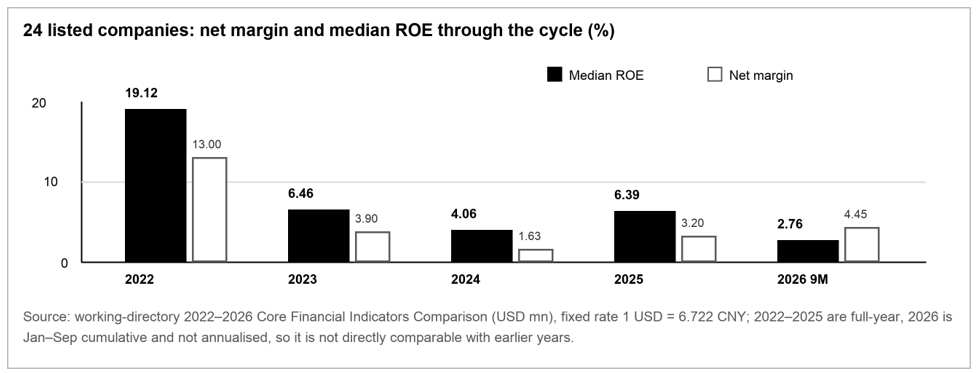
Return on equity (ROE) divergence across companies has become pronounced. Firms with high ROE generally boast strengths spanning four dimensions: product structure, competitive moats, global expansion, and new growth curves. Companies with such strengths are not necessarily the industry’s largest players. For instance, Noposion registers an ROE of 14.15%, driven by revenue growth from formulation distribution channels and its blueberry business. Guoguang achieves an ROE of 11.10%, underpinned by its plant growth regulator business, zero interest-bearing debt, and receivables equivalent to only 2.1% of revenue. CAC Nantong posts a ROE of 9.47%, with overseas exports serving as the core pillar supporting its ROE. Yangnong Chemical records an ROE of 8.91%, holding an unshakable leading position in the pyrethroid segment. Lianhua Technology delivers an ROE of 7.60%, supported by its diversified footprint covering crop protection CDMO, pharmaceuticals and new energy.
Firms at the bottom of the range include ABA Chemical at -15.33%, Sino-Agri United at -10.85%, Adama Anti- at -2.01%, and Yingtai Biotech at -1.49%. Across China’s pesticide sector, the ROE gap between top-tier and bottom-tier players exceeds 25 percentage points.
ROE divergence across companies has become pronounced. Firms with high ROE generally boast strengths spanning four dimensions: product structure, competitive moats, global expansion, and new growth curves. Companies with such strengths are not necessarily the industry’s largest players. For instance, Noposion registers an ROE of 14.15%, driven by revenue growth from formulation distribution channels and its blueberry business. Guoguang achieves an ROE of 11.10%, underpinned by its plant growth regulator business, zero interest-bearing debt, and receivables equivalent to only 2.1% of revenue. CAC Nantong posts a ROE of 9.47%, with overseas exports serving as the core pillar supporting its ROE. Yangnong Chemical records an ROE of 8.91%, holding an unshakable leading position in the pyrethroid segment. Lianhua Technology delivers an ROE of 7.60%, supported by its diversified footprint covering crop protection CDMO, pharmaceuticals and new energy.
Firms at the bottom of the range include ABA Chemical at -15.33%, Sino-Agri United at -10.85%, Adama A at -2.01%, and Yingtai Biotech at -1.49%. Across China’s pesticide sector, the ROE gap between top-tier and bottom-tier players exceeds 25 percentage points.
Notably, companies with low ROE and losses share four common characteristics: (i) low prices and volume growth without price growth; (ii) RMB appreciation driving FX losses (Rainbow Agro ~RMB402mn, Lianhetech ~RMB160mn, Lier Chemical RMB86mn — the ranking table removes FX distortion by using one rate for both periods, but reported profit and loss still bears actual FX effects); (iii) rising feedstock costs and impairments; (iv) nonrecurring items masking the core business (Red Sun’s debt restructuring, Hebang’s low prior-year tax base, ADAMA’s sale of an Israeli logistics centre contributing ~81% of attributable profit).
Corporate quarterly performance was generally weak across the board in Q3 2026. Jiangshan Agrochemical, Cynda, Wynca, y FlagChem swung to quarterly losses; the sector posted −RMB0.5bn attributable profit in 3Q26 alone. Price increases pass through to profit with a clear lag (Q3 results reflect July through September operations, while glufosinate’s rise concentrated in late September).
As for the mergers and acquisitions, it is dominated by internal restructuring, private placements, industry funds, and greenfield overseas investment; large cross-border acquisitions have cooled. Overseas expansion is via subsidiaries, land and local registrations (Hailier in Laos/Cambodia, ABA Chemicals’ Malta capex, Rainbow Agro’s US/Spain plants).
On the capital expenditure front for production capacity, 2026 investment is heavily concentrated on high-value post-patent, and new chemistries. Key molecules attracting capacity investment include fluxapyroxad, bixafen, fluopyram, chlorfenapyr, pyroxasulfone, glufosinate / L-glufosinate, prothioconazole, cyantraniliprole, y clorantraniliprol. Established bulk pesticide products have become an investment vacuum, with new TC projects at the 10,000-tonne scale growing rare. Moreover, nameplate capacity far exceeds effective realized capacity; roughly 46% of the announced nameplate capacity has not yet commenced construction. Capacity investments in Northwest China are centered on intermediates, forming a strategic pattern of “technical renovation in eastern coastal industrial parks + greenfield construction in the Northwest.”
| Type | Representative Actives | Oct-2026 Price / YTD Change |
|---|---|---|
| A High price · dense investment | Fluxapyroxad, fluopyram, bixafen, pyroxasulfone, cyantraniliprole | 16.8–80.0; −0.7% to +2.6% (two with no price series) |
| B Rising price · investment follows | Glufosinate / L-glufosinate, chlorantraniliprole, thiamethoxam, clothianidin, imidacloprid | 7.2–41.7; +15.5% to +61.9% |
| C Falling price · still dense investment | Prothioconazole, chlorfenapyr, azoxystrobin, pyraclostrobin | 14.1–20.2; −21.8% to −9.8% |
| D Falling/low price · scarce investment | Glyphosate, 2,4-D, atrazine, chlorothalonil, carbendazim, indoxacarb | 2.1–5.2; −29.7% to +15.8% |
| Core mechanism | Four of the five most-invested actives with price data averaged 48.4 in October, versus 3.15 for glyphosate / 2,4-D / atrazine with only one to two records each — a ~15-fold gap. Price is a constraint, not a trigger. About 60% of capacity investments are intermediates, adjuvants or formulations; flexible shared lines and intermediate integration are the main cost levers. | |
¡Obtenga el boletín hoy!