La relación entre China e India en materia de insumos agrícolas: tres cambios que definen el panorama de la agroquímica.
 26 de octubre de 2026
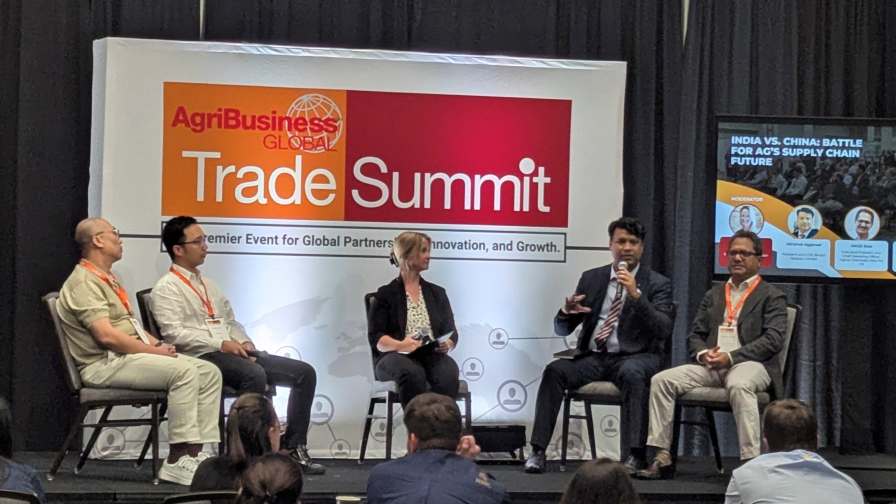
Industry experts debated whether India or China will shape the future of agricultural input sourcing, exploring cost, innovation, regulation, and supply chain resilience. The interactive session at the AgriBusiness Global Trade Summit engaged attendees in a lively exchange on global trade dynamics and the geopolitical forces shaping the future of agricultural supply chains.
En el AgriBusiness Global Cumbre de Comercio de Agribusiness Global, ag chem representatives from India and China debated which global powerhouse will define the future of ag input sourcing.
Representatives from India included Abhishek Aggarwal, President and COO of Bharat Rasayan Ltd., and Abhijit Bose, Executive President and COO of Tagros Chemicals India Pvt. Ltd. The China team comprised David Li, Vice President, SPM Biosciences, and Kevin Li General Manager of Fuhua Crop Protection Division, Tecnología agroquímica Co., Ltd. de Sichuan Leshan Fuhua Tongda
Here are three key takeaways from the discussion.
1. Trust Replaces Cost as Competitive Factor
While pure cost discussion has defined the ag chem industry over the last several years, panelists suggested the industry is gravitating more toward companies who can ensure trust, intellectual property protection, reliability, and long-term partnerships.


“The last decade was about who is the best or cheapest supplier,” Aggarwal said. “The next decade is about who is the most trusted one.”
David Li agreed.
“There’s a model called trust building,” Li said. “The first part is ability. The second is kindness — you want to help farmers. The third one is risk taking … [companies] taking the risk for farmers … understanding what the farmers really need.”
2. Supply Chain Resilience Is Key
With geopolitical issues affecting the supply chain, countries that remain resilient are poised to become the next leaders.
For instance, as the U.S.-Iran conflict impacts the whole world, Bose said the real question becomes whether this will be a new normal.
“I do not have an answer, but I think it’s better we adapt ourselves to this geopolitical scenario,” said Bose. “The faster we do it, the better for all of us.”
3. AI Capabilities Factor Into Future Ag Innovation
Looking ahead, the ability to leverage artificial intelligence will become a competitive differentiator.
While Bose and Aggarwal noted that India has grown its capacity for AI in supply chain, logistics, manufacturing, and R&D, they conceded that China is the dominant player.
“As of today, it’s China who has an upper hand in terms of the AI in ag chem and the development of new molecules,” Aggarwal said.
¡Obtenga el boletín hoy!