5 Ways Biostimulants Are Not Equal
By: Luca Bonini, CEO Italpollina (Updated 4.15.2019)
CONTACT: MONICA JOHNSON
[email protected]
In December 2018, the United States’ Agriculture Improvement Act of 2018, also known as the 2018 Farm Bill, was signed into law. This is especially interesting for growers because it included the first formal definition for plant biostimulants in any law in the U.S. The 2018 Farm Bill defines plant biostimulants, similar to the European Biostimulants Industry Council (EBIC), as “a substance or microorganism that, when applied to seeds, plants, or the rhizosphere, stimulates natural processes to enhance or benefit nutrient uptake, nutrient efficiency, tolerance to abiotic stress, or crop quality and yield.”
Having this definition makes it easier for US farmers and others in agribusiness to understand how biostimulants differ from fertilizers and crop protection to improve production quality. Defining biostimulants also establishes a clear regulatory path for continued innovation and development for manufacturers.
For farmers considering the use of biostimulants, a legal definition is just the beginning, though. There are other important factors that distinguish solutions that “meet the definition” from those that are natural, sustainable products designed to help farmers achieve high standards with fewer resources.
Surprisingly, the “best” products are not just the ones that work well. The best product that is best in the right way, is manufactured in a process that elevates it above what, on the surface, may seem like a comparable product. Because not all biostimulants are created equal, when evaluating solutions, look for a biostimulant manufacturer that can deliver on the following standards:
- Proven investment in research
One way to measure a manufacturer’s commitment to research is in the company’s facilities and employees. You need labs, greenhouses, scientists and researchers to have a deep understanding of how and why products work. Without investment in exploration and learning, a manufacturer cannot provide sustainable solutions. In addition, manufacturers who truly understand what farmers need, don’t limit their R&D resources to inventing new solutions; they also find ways to create superior alternatives to existing products. Which leads to the next thing to look for:
- Innovative production technologies
When manufacturers have developed their own, proprietary production technologies, they can produce biostimulants in a way that no other manufacturer does. Their facilities and processes are designed to provide exclusive results that may provide cleaner and more efficient biostimulants. Or, they may discover technology that is not reliant on mixing ingredients from various sources to create products. Rather they may develop a specific process that allows them to control the quality of source ingredients, as well as the production process, to obtain the consistent quality of product desired. This type of innovation could lead to more predictable, consistent crops, so farmers can better plan yield and potential revenue.
- Trial period and field support for farmers
Manufacturer-conducted field trials and reports are a good place to start the evaluation process, but the real proof is in what happens in a farmer’s own field. That’s why choosing a manufacturer that provides education and technical support while farmers conduct their own trials is essential. Along with a hands-on approach to helping farmers, manufacturers that host continuous training and educational workshops for farmers, distributors and other constituents are more connected to what’s happening in the industry and are better able to provide solutions that meet growers’ needs. Collaboration and partnerships with universities demonstrates a commitment to tomorrow’s farmers, as well.
- A commitment to agricultural sustainability
It’s no secret the safety of certain agricultural practices have come into question, and growers are under more scrutiny than ever before. It falls on manufacturers to take responsibility for protecting farmers, consumers and natural resources. Manufacturers that today follow a model of eco-efficiency – respect for the environment, use renewable resources, and create products that meet the highest quality standards – will continue to develop new, innovative and sustainable solutions for the future.
- Deep industry roots and history
Modern technology has made the production of biostimulants possible, but the best solutions go deeper than technology. Manufacturers with a long history in agriculture have institutional knowledge that translates into an understanding of the language of plants, their life, biology, needs and issues. A company that is active in trade associations, is influential in the business, and has deep industry roots is more likely to have sustained growth, global reach and the experience farmers need so they can thrive.
It is clear biostimulants will continue to have a major influence on agriculture in the states and around the world. Manufacturers, like Italpollina, (see side bar) that have ongoing research and innovative production technologies, provide a strong support network, protect the environment, and believe they can make a difference, will lead the way in helping farmers take care of their crops in a natural and innovative way for a more sustainable future.
| As growers continuously look for ways to increase their per-acre yield, many are looking to the biostimulant segment of agricultural inputs. Given its tremendous growth potential, it is easy to see why the biostimulant segment has been flooded with new products. Italpollina, a global leader in the production of organic fertilizers, beneficial microbials and natural biostimulants, has a long history of producing products that help growers gain consistent increases in crop yield. Their innovative products are the result of 50 years of continuous research and experimentation, and the company has the largest production capability of 100% vegetal-based (protein hydrolysate) biostimulants in the world. According to a recent scientific article published in Frontiers in Plant Science, “plant-derived protein hydrolysates [the source product in STIMTIDE – see trial data below; and in TRAINER see advertisement] have gained prominence as plant biostimulants because of their potential to increase the germination, productivity and quality of a wide range of horticultural and agronomic crops. Additionally, application of protein hydrolysates can alleviate the negative effects of abiotic plant stress due to salinity, drought, and heavy metals, plus increase nutrient uptake and nutrient-use efficiency in plants.”(1) . For more information, visit www.italpollina.com AUTHOR=Colla Giuseppe, Hoagland Lori, Ruzzi Maurizio, Cardarelli Mariateresa, Bonini Paolo, Canaguier Renaud, Rouphael Youssef; TITLE=Biostimulant Action of Protein Hydrolysates: Unraveling Their Effects on Plant Physiology and Microbiome; JOURNAL=Frontiers in Plant Science; VOLUME=8; YEAR=2017; PAGES=2202; URL=https://www.frontiersin.org/article/10.3389/fpls.2017.02202; DOI=10.3389/fpls.2017.02202; ISSN=1664-462X; |
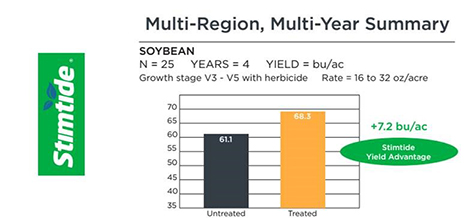
The summary of 25 trials of the use of Stimtide on soybeans over 4 years shows a consistent and significant increase in yield.