


Brazil’s experience in nematode control: Frontier exploration of biological solutions
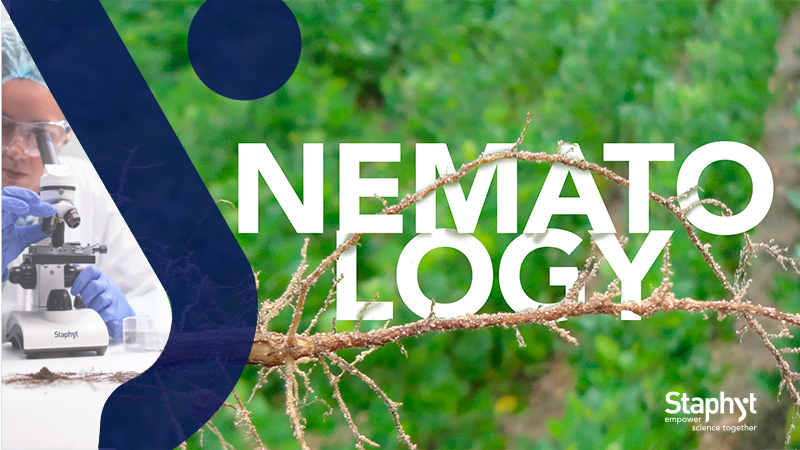
Plant-parasitic nematodes, which feed on plant roots, are often referred to as the “invisible killer” in agriculture. Despite being difficult to detect due to their hidden activity in the soil, they are highly destructive – causing an estimated $150 billion in global crop losses annually. These pests damage root structures, reduce the ability of crops to absorb water and nutrients, and create conditions conducive to fungal infections, posing a serious threat to both crop health and yields.
Because nematodes are hard to observe and diagnose in the field, their impact is frequently underestimated. However, their growing threat has made the development of efficient, accurate, and sustainable management strategies a pressing global challenge. In this context, biological solutions have emerged as a vital component of integrated nematode management (INM).
Brazil, as one of the world’s leading agricultural producers, has become a focal point for the adoption and scaling of biological nematode control technologies. Through a combination of government policy support, enterprise-driven R&D, and the integration of innovative technologies, Brazil is actively advancing biological approaches to tackle major crop pests and diseases.
Brazil’s experience offers a replicable model with strong relevance for global agriculture. Its progress not only demonstrates a practical path for nematode management but also contributes to the broader transformation toward greener, more efficient, and more sustainable agricultural systems, offering valuable insights for international reference.
Nematodes: A Pressing Threat to Brazilian Agriculture
Plant-parasitic nematodes have become one of the most destructive pests in Brazilian agriculture, posing a major threat to staple crops such as soybeans, corn, and sugarcane. These microscopic soilborne organisms feed on plant roots, compromising crop health from the seedling stage and significantly reducing both yield and quality.
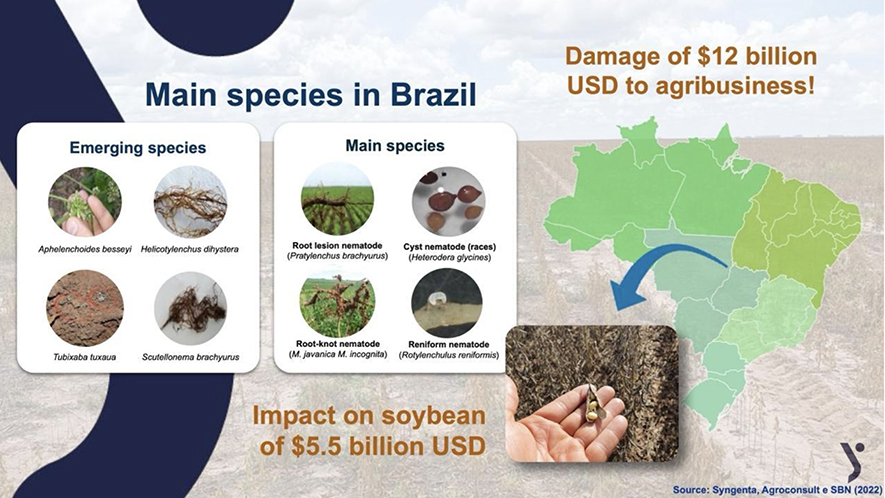
In soybean-producing regions, common species include root-knot nematodes (Meloidogyne javanica, M. incognita), root-lesion nematodes (Pratylenchus brachyurus), and cyst nematodes (Heterodera glycines). These pests damage root systems and disrupt the uptake of water and nutrients, resulting in stunted growth, uneven crop stands, and large gaps in fields—ultimately leading to substantial yield losses.
Brazil’s unique climatic conditions and intensive cropping systems further aggravate nematode proliferation. In many regions, winters are virtually nonexistent and temperatures remain high year-round, often reaching 46°C in summer and around 26°C in winter. These conditions allow for two to three cropping cycles per year, significantly extending the nematodes’ activity period and providing ample opportunities for reproduction. High-frequency crop rotations, such as soybean, corn, cotton, offer a continuous host environment, making it difficult to disrupt the nematode life cycle and intensifying the challenge of management.
Adding to the complexity, new nematode species have emerged in recent years, including Aphelenchoides besseyi and Helicotylenchus dihystera. These species spread rapidly, have wide host ranges, and often coexist with traditional nematodes, complicating diagnosis and control efforts. For example, Helicotylenchus dihystera can cause uneven crop height and stunted growth across fields, now a growing concern in many agricultural zones.
According to recent research and field monitoring by Staphyt, nematodes cause annual economic losses of USD 5.5 to 12 billion in Brazil, amounting to nearly 7% of the country’s total agricultural output. Soybeans alone suffer USD 4 to 5 billion in losses, making nematodes the number one agricultural pest in the country. Of more than 20,000 field samples collected nationwide, nematodes were detected in over 95%, underscoring both their widespread distribution and significant economic impact.
Clearly, nematodes have become a critical challenge to the sustainable development of Brazilian agriculture and require urgent, integrated, and innovative management strategies.
The Nematode Management Dilemma: Challenges Facing Farmers
As underground and often undetectable pests, nematodes present unique challenges in agricultural management. Once they infest a field, they are extremely difficult to eradicate. The prevailing consensus is that management, not eradication, is the most realistic goal. Because nematodes can cause irreversible root damage, long-term success depends on continuous monitoring and scientific, integrated management. However, for many farmers, this remains a complex and ongoing challenge.
In practice, farmer awareness of nematodes is generally low. Despite widespread nematode pressure across farmland, many producers do not recognize the problem until significant yield losses occur. The subtle and often invisible symptoms of root damage make early detection and timely intervention difficult. This underscores the need to strengthen farmer education, improve diagnostic capacity, and raise awareness of the importance of early action.
A further complication lies in the tension between economic gains and pest control compliance. In Brazil, the common soybean, corn–cotton rotation system is economically attractive but also contributes to nematode build-up and spread. When experts recommend disrupting this cycle or adjusting planting structures to control nematodes, farmers are often reluctant due to economic concerns. This conflict between agronomic best practices and financial incentives is one of the key barriers to effective nematode management.
At the same time, traditional chemical nematicides are being phased out due to concerns over environmental residues and tighter regulatory standards. New chemical products face long approval processes, limited efficacy, and usage restrictions—creating an urgent need for safe, effective, and sustainable alternatives.
In this context, biological nematicides are rapidly gaining traction. In Brazil, adoption has risen from 27% three years ago to over 40% today, making them a central pillar in future nematode management strategies. While challenges remain, policy support and technological advances are driving momentum, and biological solutions are poised to play an increasingly vital role in Brazilian agriculture.
Biological Agents: A Rising Force in Nematode Management
In recent years, Brazil has made notable strides in biological agriculture, particularly in the development and adoption of biological crop protection products. According to data from Staphyt, over 50% of current R&D efforts in Brazil are focused on biologicals. Among them, bionematicides have shown consistent growth over the past six years, with the market now valued at 200 billion reais, representing 4–5% of the overall pesticide market. With an average annual growth rate of 15–20%, this far outpaces the 4% growth seen in traditional chemical pesticides.
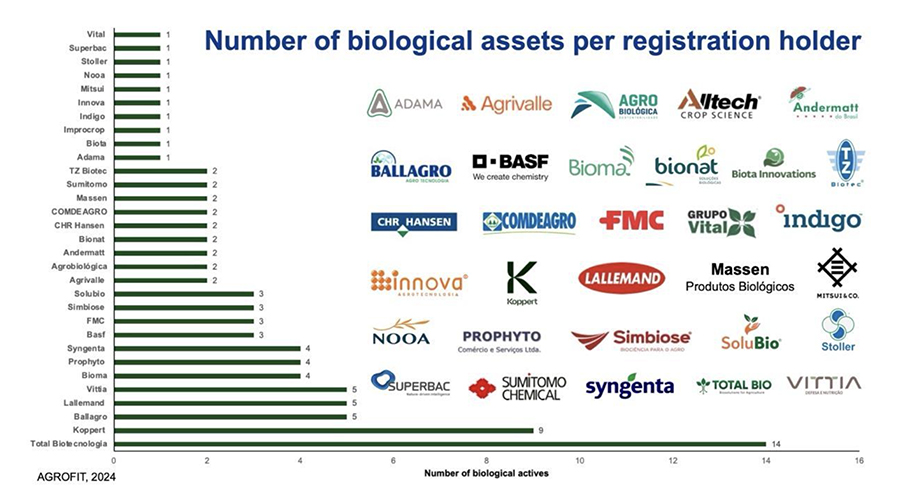
Amid increasing regulatory restrictions on highly toxic chemicals, the registration of biological agents has surged. In 2024 alone, over 12 new bionematicides were approved. The diversity of microbial active ingredients has also expanded rapidly—from just a handful 15 years ago to 99 currently registered strains. Today, Bacillus and Trichoderma are among the dominant microbial genera used in nematicidal formulations. Application data shows a near-equal split between bacterial and fungal agents, with multi-strain formulations emerging as a key trend to address multi-target and complex nematode populations.
On the corporate front, Brazilian companies such as Ballagro, Lallemand, and Vittia have taken active roles in product development and commercialization. At the same time, global agrochemical firms are increasing their participation through partnerships and joint ventures. Institutions like Staphyt are working closely with international stakeholders to accelerate registration processes, technology innovation, and product pipeline expansion, helping strengthen the competitive edge of Brazil’s biologicals sector.
Overall, Brazil is undergoing a structural transformation in its crop protection industry, with biologicals becoming a central pillar of future growth. As a strategic sub-sector, bionematicides are poised to play a critical role in driving the sustainable evolution of Brazilian agriculture.
Field Application: Data-Driven Evidence from Brazil
As nematode pressure intensifies across Brazil, the use of biological nematicides has entered a new phase focused on field validation and technological refinement. To assess real-world efficacy, Staphyt has conducted extensive field trials through its nationwide network of experimental stations. These trials evaluate the impact of different application methods on both nematode control and crop yield improvement.
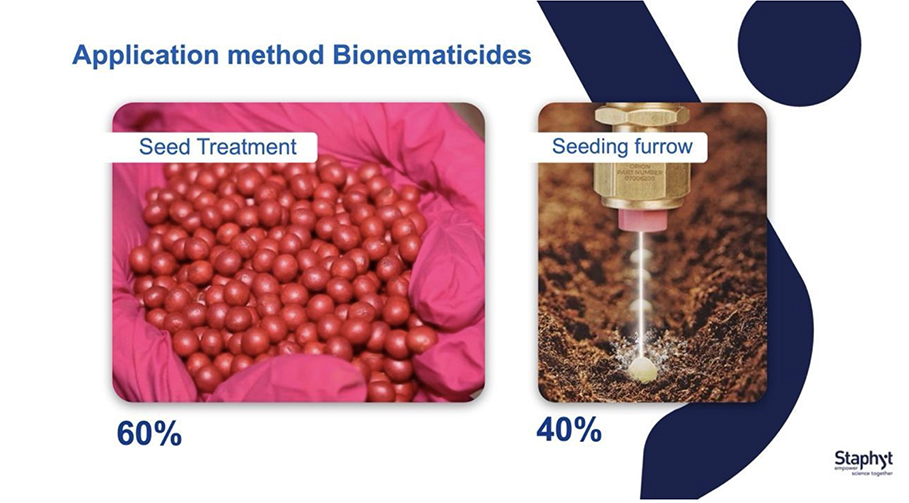
Currently, two main application methods are being promoted: seed treatment and in-furrow application.
- Seed treatment is widely adopted by large-scale growers managing 10,000–20,000 hectares, as it requires no additional water and integrates well with mechanized planting systems. However, its implementation is often constrained by the limited capacity of seed coating—farmers frequently add inoculants and adjuvants, leaving little room for nematicides in the seed treatment mix.
- In-furrow application, by contrast, offers greater flexibility and is particularly effective for multi-target pest management. Some farmers are now combining seed treatment with in-furrow application to enhance the coverage and persistence of nematicidal activity in the soil.
Field trial results show that plots treated with biological nematicides achieve an average yield increase of 6–10%, demonstrating notable economic benefits and reinforcing farmer confidence in adopting these solutions.
Given the growing nematode threat to staple crops such as soybeans and corn, the development of compound formulations and multi-target application strategies is increasingly essential. The integration of biological agents with precision application technologies represents a key pathway toward achieving efficient, sustainable pest management in Brazilian agriculture.
Future Outlook and Conclusion
In Brazilian agriculture, soybeans and corn remain the cornerstone crops, with extensive acreage and significant economic importance. However, nematode pressure continues to escalate, becoming one of the most critical biological stressors threatening crop yield and quality. Even when farmers shift to other cash crops, nematode persistence and adaptability often lead to cross-crop infestations, posing broader risks to agricultural ecosystems.
In light of this, Dr. Luiz Antonio Alves Jose, Head of Staphyt Brasil, urged farmers to reframe their perception of nematodes. He emphasized that complete eradication is unrealistic, and that management—not elimination—is the practical objective. Given the increasing complexity of nematode species and their resistance patterns, relying solely on chemical nematicides is no longer sufficient. Instead, farmers are encouraged to adopt integrated nematode management (INM) strategies that combine crop rotation, resistant varieties, and biological control agents to build more robust and resilient pest management systems.
While biological solutions are not a universal remedy, their adoption in Brazil is accelerating and becoming increasingly mainstream. Supported by precision application technologies such as seed treatment and in-furrow application, biological nematicides are demonstrating significant yield benefits alongside environmental advantages, offering a promising path toward sustainable agriculture.
Luiz concluded by stressing that the long-term solution to the nematode challenge lies in two key pillars: continuous technological innovation and farmer education at the grassroots level. By developing formulations tailored to local agro-ecological conditions, promoting science-based application practices, and enhancing farmers’ awareness and operational capacity, Brazil can pave the way for a win-win model, effectively managing nematodes, securing crop productivity, and advancing agricultural transformation.