Africa’s Crop Protection Market Enters a New Era of Opportunity and Uncertainty
 20 de agosto de 2026
 Editor’s Note: Market values are AgbioInversores estimates of the value of crop protection products used on the ground in the agricultural year, expressed in U.S. dollar terms at the ex-manufacturer level. For southern hemisphere countries, the agricultural year is approximately July to June. For example “2024” refers to the value of products used on the ground between July 2023 and June 2024. The most recent full data year available is 2024.
The African agricultural sector has long been considered a promising growth opportunity for international agribusinesses, with market penetration in the region a key component of many companies’ corporate growth strategies.
Compared to more developed agricultural industries, such as in Europe and North America, crop yields and efficiencies tend to be lower in African markets due to a combination of factors, including but not limited to weather, access to finance, use and availability of technology, crop husbandry, and infrastructure. Within these challenges exists opportunities to capitalize on enhancing efficiency within the food production value chain.
Africa bridges the Equator and is the world’s second largest continent surrounded by major seas and oceans: the Mediterranean, the Red Sea, the Indian, and the Atlantic Oceans.
The African continent is made up of 54 countries that can be divided into eight major physical regions:


- The Sahara Desert, covering 8.5 million square kilometers in Africa’s northern bulge.
- Sahel, a band of semi-arid land forming a transition zone between the Sahara to the north and the savannas to the south. It is made up of flat, barren plains stretching across Africa from Senegal to Sudan.
- Ethiopian Highlands, a mountainous region that includes the Great Rift Valley.
- Savanna, more than 13 million square kilometers of grassland that cover almost half the continent and include the Serengeti plains.
- Swahili Coast, 1,610 kilometers bordering the Indian Ocean from Somalia to Mozambique.
- Rainforest, concentrated in Central Africa along the Congo River Basin.
- The African Great Lakes, located in nine countries that surround the Great Rift Valley.
- Southern Africa, consisting of 10 countries with diverse climates including savannas, deserts, and mountains.
Of equal importance from an agricultural point of view is water availability and climate.
Africa appears blessed with abundant water resources, with large rivers including the Congo, Nile, Zambezi, and Niger, with the continent also containing Lake Victoria, the world’s second largest freshwater lake by surface area.
However, Africa is the second driest continent in the world, after Australia, and millions of Africans still suffer from water shortages throughout the year, often due to problems of uneven distribution.
A broader-based division of the continent is North Africa and Sub-Saharan Africa. North Africa comprises the countries that border the Mediterranean Sea. Sub-Saharan Africa are the lands south of the Saharan desert comprising a wide range of physical geographies (rainforest, deserts, plains, and mountains). Northern Africa has 92% safe water coverage, while Sub-Saharan Africa remains at a low 60% of coverage — leaving 40% of the 783 million people in that region without access to clean drinking water.
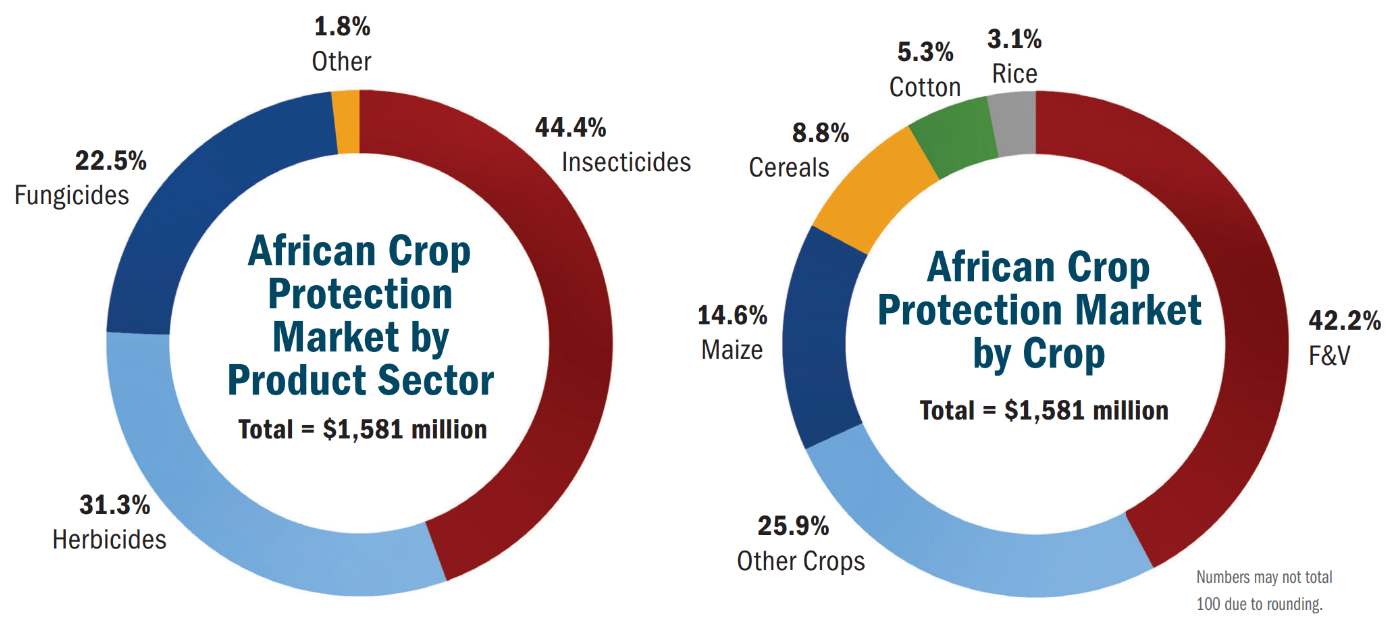
Source: AgbioInvestor
In the 2000s, Africa has recorded the greatest population growth rate worldwide, more than any other region and double the world average. Clearly a major challenge is to feed this growing population, which puts pressure on agriculture, already a significant part of GDP, directly linked to rural population.
Crop Protection Market
The value of African crop protection markets has been based on a triangulation of publicly available data, crop areas, pesticide trade and usage data, and market research data (where available, AgbioInvestor).
The African crop protection market is fairly evenly split between the four major geographic regions. Western Africa has a larger share of the cropland area (arable area and permanent crops), while Southern Africa has a smaller share. The data indicates a greater intensity of crop protection product usage in Southern Africa and more extensive farming in Western Africa. Cereals include wheat barley, millet, sorghum, and other small grains. Fruit and vegetables include potato, vine, pome and stone fruit, and cassava, groundnut, cow pea, dry beans/pulses, yam, and banana/plantain sectors. Other crops include cocoa, coffee, rubber, tea, oil palm, and tobacco.
AgbioInvestor analysis shows that all sectors of the African crop protection market have increased in the last five years, but herbicides and fungicides at a greater rate than the more established insecticides market.
Vector control has been a major element in the African agrochemical market for many years, particularly in areas where pasture and animal rearing predominate. As a result, using agrochemical trade data to determine crop protection market sizing is complicated by insecticides imported for ectoparasite, mosquito, and locust control.
The countries with the largest crop protection markets are also those with the largest GDP, namely South Africa, Nigeria, Egypt, Morocco, and Kenya. Agriculture is of critical importance to many African countries, accounting for >20% of GDP in five of the top 12 markets and >25% of employment in all but two of the top 12.
Panorama general
The recent inflation of global fertilizer prices amid increasing geopolitical tensions, shipping disruptions, and production cuts is expected to have a significant impact on the crop protection market in Africa. Due to the current conflict in Iran, transit through the Strait of Hormuz and regional production of nitrogen and plant nutrients, such as urea, diammonium phosphate, and sulfur, have essentially ceased, with major fertilizer plants within the region shutting down. As a result, fertilizer prices are anticipated to increase, especially for urea. This comes amid already elevated fertilizer prices arising from restricted imports into China and reduced fertilizer production in Europe.
More than 90% of Africa’s fertilizer requirements are imported, leaving the region particularly vulnerable to issues related to shipping disruptions. For countries in the southern hemisphere, the worst effects are not expected until planting commences later this year. However, northern hemisphere countries in the region are expected to experience similar issues to growers in other northern countries, but amplified due to reliance on imports and proximity to the conflict zone: higher fertilizer and fuel costs, reduced spending power on pesticides, and potential price increase of those pesticides.
As a result of the above factors, the crop protection market in Africa is expected to be challenged in 2026, with any potential pesticide price improvement related to production and supply issues being offset by reduced spending power, lower applications, and a switch to lower cost products.
¡Obtenga el boletín hoy!