PowerSOIL: The Complete Path to Fertile Soil and a Profitable Crop
Before talking about regeneration, it is worth pausing on a more basic question: what do we really mean by soil? In agriculture, it is still common to view soil as the medium that anchors roots and supplies water and nutrients to the crop. However, that view leaves out a fundamental part of how it works: soil is not an inert substrate, but an ecosystem in constant activity, where minerals, organic matter, microorganisms, water, air, and roots interact.
That is why talking about soil health means looking beyond chemical analysis. Structure, organic matter, and especially microbial activity are part of a system that determines the soil’s capacity to store, transform, and make nutrients available to plants. When soil biology weakens, nutrient use efficiency declines and the crop loses its ability to express its potential.
The challenge is not only to correct a specific deficiency, but to restore the conditions that allow the soil to function as a productive ecosystem. From this perspective, Grupo Silvestre, through its European subsidiary Edalife, presents its POWERSOIL system, a comprehensive program designed to regenerate soil functionality through biological, structural, and stimulant tools. Its approach rests on a simple principle: if the goal is for the crop to produce more, it is vital to start by restoring the environment in which its roots must develop—the soil and the rhizosphere.
Building on this approach, Edalife works with programs that begin with a diagnosis of the physical, chemical, and biological conditions of each soil to determine which processes need to be restored. The proposal is not limited to a single, isolated tool. The aim is to integrate solutions that act on different components of the system and that, by complementing one another, make it possible to bring about changes that would be difficult to achieve by addressing each problem separately.
This vision was put to the test on an export strawberry farm in Huelva, Spain, where the POWERSOIL system was implemented. The objective was to evaluate the extent to which the system could change the functioning of a soil that, at first glance, showed no severe chemical degradation, with the ultimate goal of improving the crop’s economic performance.
The initial diagnosis showed precisely that apparent contradiction. The soil had adequate levels of phosphorus and calcium, as well as a neutral pH. However, organic matter barely reached 0.6%, and the E.S.H.I. Fertility Index started at 3.07. More importantly, the analyses revealed very low biological activity, with a virtually nonexistent presence of bacteria, fungi, mycorrhizae, and Rhizobium.
In other words, the nutrients were there, but the biological system capable of actively participating in their utilization was missing. This diagnosis was the starting point for designing a program specific to the field conditions, using alternating applications aimed at improving soil structure, stimulating its biological activity, and promoting crop development.
| Function | Tool | Composition |
| Structuring | DARKGOLD | Micronized natural leonardite |
| Biological regeneration | XURIAN | High-resistance rhizosphere bacteria. |
| MYCONATE | 40% formononetin | |
| Crop stimulation | DARKLAND | Liquid suspension of high-molecular-weight carbon chains |
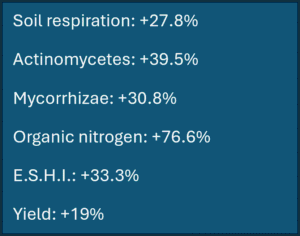
After five months, the findings were revealing, and most of the changes point to the same driver: microbial activity. The soil respiration rate—the signal that indicates how much life is really at work beneath the surface—was 27.8% higher than in the control plot under conventional management. That biological “awakening” did not occur in isolation: it translated into an explosion of actinomycetes (+39.5%) and mycorrhizae (+30.8%), the root’s two great allies for breaking down complex organic matter and absorbing nutrients with an efficiency that no soluble fertilizer can match on its own.
And this is where the story gets really interesting: that expanding microbial community began to capture and reorganize the soil’s nutrients. Organic nitrogen rose 76.6% and organic phosphorus 26.5% compared with the control plot. Far from being lost to leaching in their soluble form—as often happens in soils with poor biology—these essential nutrients were incorporated into the microbial biomass and the soil’s organic reserves, becoming a slow-release, stable, and long-lasting source of fertility.
This helps explain something that might go unnoticed at first glance: minerals such as phosphorus, zinc, or copper, which on a superficial reading would seem simply “consumed,” are in fact being recycled with far greater biological efficiency, precisely thanks to that jump in mycorrhizae and actinomycetes. The soil is not losing nutrients; it is moving them into a smarter system, where biology itself takes charge of managing them and making them available to the crop when they are needed, instead of leaving them vulnerable to leaching.
The result of this entire process comes down to a single number, the most integrative of all: the E.S.H.I. Fertility Index, which ended up 33.3% above the control plot. It confirms that this is not a one-off improvement, but an entire ecosystem reactivating, layer by layer: more organic matter, more available carbon, more microorganisms, more nutrient cycling.
That, ultimately, is the real contribution of an integrated regenerative system such as POWERSOIL: it does not deliver a temporary nutrient boost; it rebuilds the soil’s natural capacity to generate its own fertility, in a sustained and increasingly autonomous way. The difference between feeding one harvest and regenerating a productive system for the harvests to come.
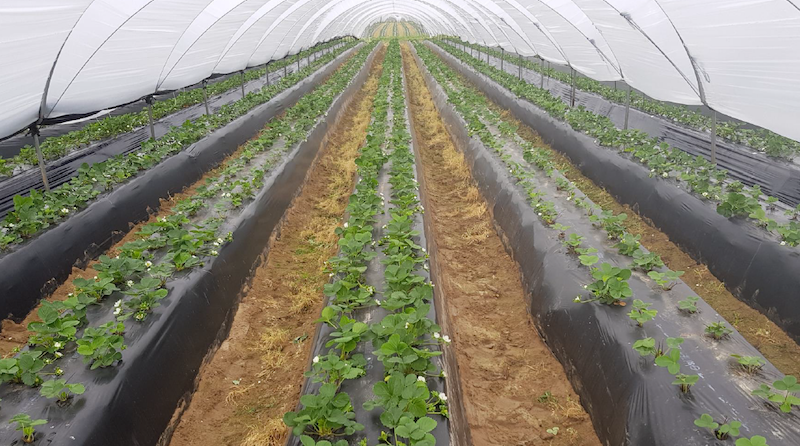
The plot’s initial condition before treatment with the POWERSOIL system.
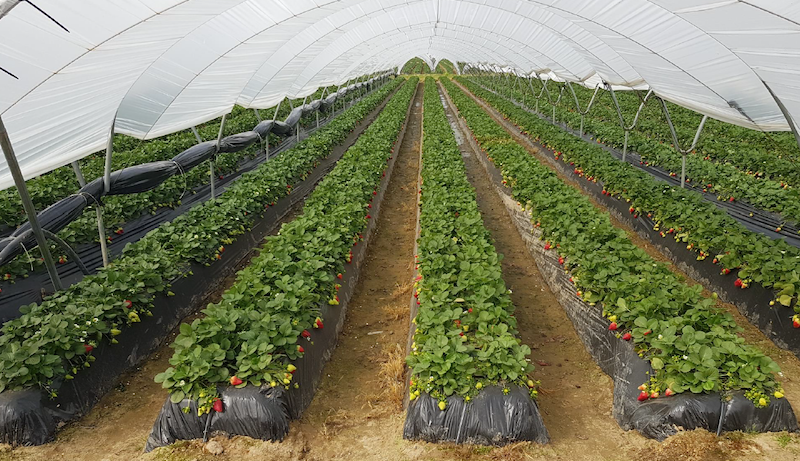
The changes visible five months later.
When Regenerating Soil Sustainably Delivers Greater Profitability
These results debunk a widespread notion in the industry: that sustainability and profitability are at odds. On this farm, restoring soil biology not only improved its fertility, but also translated into a 19% increase in yield. Regenerating the soil was not an added cost, but the foundation of economic performance. “The proposal is not limited to a single, isolated tool. The aim is to integrate solutions that act on different components of the system and that, by complementing one another, make it possible to bring about changes that would be difficult to achieve by addressing each problem separately”- Luis Gámez, CEO of Edalife