Why Plant Health Is Becoming Essential in Latin American Agriculture
 30 March 2026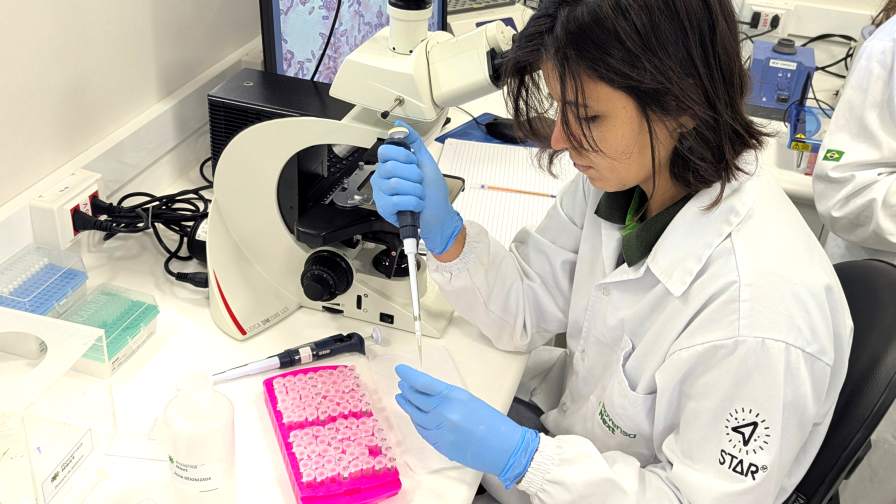
In Brazil, an employee conducts trials at the Rovensa Next Global Research and Innovation Center for Biosolutions at Hortolândia, which is nearby the company’s new fermentation plant in Monte Mor.
Across Latin America, growers’ adoption of plant health products is increasing to restore soil function, diversify pest and disease control strategies, and boost crop efficiency amid an increasingly variable climate.
“It is not simply a technological innovation but a profound shift in production systems, combining scientific rigor, economic sustainability, and intergenerational responsibility,” says José Manuel González Petit, Head of LATAM at Rovensa Next.
The growth of the plant health market in LATAM is also the result of policies surrounding maximum residue limits (MRLs) for regions like the EU, where many LATAM crops are exported.
“The trend is to use more biorational products that leave no residues on exported fruits and vegetables,” says Gabriel Ormeño Hofer, General Manager of Chile Anasac SA. “Market demands, especially in Europe, are becoming increasingly restrictive regarding MRLs.”

Market Overview
Historically, European players have dominated the biostimulant market, but according to DunhamTrimmer’s 2025 Global Report, “Latin America has consolidated its position as the leading market in both value and growth, with Brazil contributing half the region’s revenue.”
Manel Cervera, Managing Partner and Chief Commercial Officer at DunhamTrimmer, points to the rise of strong local champions as a reason for this shift.
“We’ve seen local companies developing their products and taking advantage of understanding the appropriate regulatory, administration, and political pathways and [having] access to the raw materials,” Cervera says. “It’s also the deep understanding and connection with the local players, with the local channel.”
In addition to Brazil, González Petit says Argentina, Peru, Chile, Colombia, and Ecuador are also leading the adoption of these technologies, each developing specific application strengths depending on their dominant crops and regions. He adds that these countries, together with Central America, are taking increasingly prominent positions in terms of food exports to the U.S. and Europe, with tariffs imposed on historically major exporting countries and the new Mercosur free trade agreement with the European Union.
Regulation: A Key Challenge in LATAM
Regulations remain a key challenge of getting these types of products to market in LATAM.
On one side of the spectrum, Brazil’s government has clarified and simplified the regulatory pathway, says Sarah Reiter, Executive Vice President of BioConsortia.
“In recent years, Brazil has had very clear pathways for regulating biocontrol, biofertilizer, and biostimulants, and I think that gives them an advantage versus some other countries in that space where it’s not entirely clear,” Reiter says.
In Chile, at the other end of the spectrum, there is only one set of regulations that covers all products that eliminate fungi, bacteria, pests, weeds, and growth regulators, Ormeño Hofer says.
“We eagerly await the separation of biological products from those of chemical synthesis,” says Ormeño Hofer. “Today, to enter the Chilean market and succeed, you need patience, complete data to register any type of product — the time is four to five years — and most importantly, an access channel, which in Chile is quite limited.”
Other countries are working to address these regulatory holdups.
In Argentina, for example, the regulatory framework for plant health products is undergoing a transformation, according to Federico Alonso-Hidalgo, General Manager of Gleba SA.
“Authorities are reviewing existing registration processes with the aim of reducing bureaucracy and improving efficiency,” Alonso-Hidalgo says. “Although these reforms are still in progress, they could eventually shorten approval timelines and improve access to new technologies for farmers.”
Looking Ahead
As a potential game-changer going into the future, DunhamTrimmer highlights the emerging single biostimulant molecule market, focusing on products that offer higher specificity and more consistent efficacy (with reduced dependency on agronomic conditions), potentially unlocking large-scale adoption in row crops and cereals.
“Biostimulants are linked more than other agricultural inputs to agroclimatic conditions, so if companies are starting to develop more concrete molecules and metabolites, they can offer high-efficacy results in a more consistent and replicable way,” Cervera says. “We need to see if these companies can develop commercial feasible products, but if they succeed on that, that could be a game-changer.”
Get The Newsletter Today!