Beyond the Science: What Biological Startups Must Do to Win Strategic Partnerships
 3 June 2026
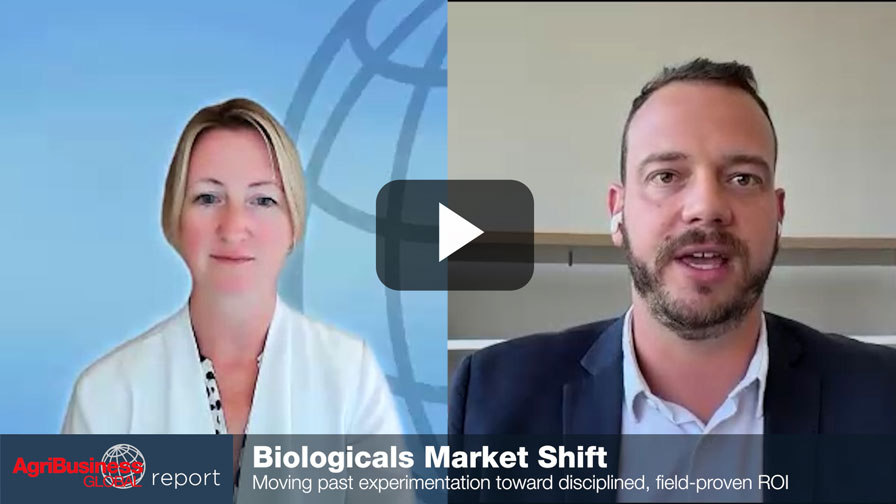
 At a recent webinar hosted by AgriBusiness Global titled “Biological Expansions: How To Stay Competitive,” industry leaders explored one of the most pressing questions in the biologicals sector: how can smaller biological companies and startups position themselves to attract partnerships with larger players? Panelists included Sebastian Bachem, CEO of Accumont, José Nolasco, Head of Global R&D Bionutrition at Rovensa Next, Kevin Price, Head of Corporate Affairs at Certis Belchim, and Ignacio Moyano Córdoba is Vice President of Business Development, LATAM, for DunhamTrimmer., These experts shared candid insights into what larger companies and investors are really looking for in today’s increasingly competitive biologicals market.
 AgriBusiness Global Trade Summit: Where Markets Connect
Join global crop protection and plant health leaders in Las Vegas in August for sourcing, networking, and market insights. Learn more >>
As biological crop inputs continue to gain momentum globally, opportunities for collaboration are expanding. But panelists agreed that interest from major companies is no longer driven by promising science alone. Startups must demonstrate that their technologies are differentiated, scalable, commercially viable, and capable of reducing risk for potential partners.
Differentiation Starts With Science — But Doesn’t End There
For Nolasco, differentiation begins with science — but it cannot stop there.
“Be super selective,” he advised startups seeking partnerships. “You have to demonstrate that you have differentiation, not only in your product, but in your science.”


He emphasized that biological efficacy backed by strong field validation is essential because biological products often face a significant gap between laboratory performance and real-world field results.
“You can have an incredible biological formulation, but finally it’s not doing anything in the field,” Nolasco said. “This gap between the lab and the field is a key element.”
According to Nolasco, startups also need to prove they can scale commercially. Too often, larger companies encounter startups with exciting concepts but no manufacturing capabilities or operational pathway to commercialization.
“In one second you realize they’re not able to do anything because there’s no factory, no process, nothing — only one idea and one lab,” he said.
Beyond scalability, he identified intellectual property ownership and regulatory readiness as critical checkpoints. Companies must clearly demonstrate they own or control their technology and understand the regulatory pathway required for commercialization.
Most importantly, however, startups must clearly define the value proposition for growers.
“What is the return on investment for the farmer?” Nolasco asked. “This is the critical element.”
He summarized the priorities of large companies succinctly: “Big companies never buy a product. The company buys risk reduction, acceleration on market access, and strategic fit.”
Large Companies Need More Than a Promising Technology
That focus on practical business value was echoed by Price, who noted that larger companies are approached constantly by startups claiming to have breakthrough technologies.
“Our problem is how do we differentiate between one and the other? How do we know which horse to back?” he said.
For startups to stand out, Price explained, they must arrive with a well-developed understanding of the market opportunity and the specific grower problem they are solving.
“Does this really meet an unmet need?” he asked. “Is it addressing a challenge growers are currently facing or will face?”
He added that understanding the grower value proposition is fundamental because developers and marketers rely heavily on the information startups provide during initial discussions.
“It’s not enough just to come with a description of this new technology,” Price said. “We need much more than that.”
Economic viability also plays a major role in partnership decisions. Large companies evaluate production costs, market pricing, competitive positioning, and overall profitability potential before moving forward.
Field Validation and Market Focus Matter
Sebastian Bachem stressed the importance of field trial data and maintaining a focused commercial strategy early in development.
“When companies come to Accumont, we ask them, what is your proof of concept in the field?” he said.
Bachem warned startups against trying to tackle too many markets or applications at once. Instead, he encouraged companies to focus on a niche segment where they can establish credibility and demonstrate clear value.
“You can’t boil the ocean,” he said.
Differentiation remains essential, but Bachem emphasized that startups also need to understand the broader competitive landscape, including adjacent technologies that could eventually disrupt their solution.
“You really have to understand the whole area that you’re working in,” he explained. “Why is this going to be attractive to companies that will really prick up their ears?”
He noted that technologies such as resistant crop varieties or alternative pest-control solutions could quickly shift market demand, making strategic positioning even more important.
Investors Are Looking for “Camels,” Not Unicorns
Moyano Córdoba agreed that the biologicals market has matured significantly, making investors and multinational companies far more selective than they were just a few years ago.
“They are no longer looking for only a simple product with an interesting story,” he said.
Today, larger companies are increasingly searching for technology platforms capable of supporting multiple applications and integrating into broader crop management programs.
“Innovation alone is not enough,” Moyano Córdoba said. “They need to show real validation in the field, measurable agronomic results, consistency across crops, regions, and seasons, and a clear economic benefit for farmers.”
He added that startups must also demonstrate operational readiness, including formulation stability, quality control, manufacturing reliability, and supply capacity.
Equally important is presenting a complete business case that outlines market size, adoption potential, target crops, application rates, and portfolio compatibility.
“Today a good product alone is not enough,” he said. “Companies are looking for integrated solutions that reduce risk, complement strategy, and can scale commercially.”
Moyano Córdoba closed with a metaphor increasingly heard among investors evaluating ag biological startups.
“Many investors today are no longer asking for a unicorn,” he said. “They are asking for a camel — a company that uses capital very carefully, survives difficult cycles, and can cross long deserts before reaching success.”
Execution Will Define the Next Generation of Winners
As the biologicals sector continues its rapid evolution, the message from industry leaders is becoming clear: successful startups will be those that combine strong science with disciplined execution, market understanding, and commercial readiness.
To hear the full discussion and additional insights from the panelists, view the complete webinar here.
Get The Newsletter Today!