As China Exports More Formulations, Quality Needs to Become More Visible
Formulated products have become an increasingly important part of China’s pesticide exports. In 2024, formulation exports exceeded technical materials in value for the first time, reaching RMB61.36 billion and accounting for 54.12% of pesticide export value.
The momentum has continued. China Customs data analyzed under HS 3808 show pesticide formulation exports of $2.35 billion in the first quarter of 2026, followed by a record $3.13 billion in the second quarter. Q2 export volume reached approximately 1.05 million metric tons, up 16.3% year over year.
Meanwhile, China has changed part of its export-tax structure. Beginning April 1, 2026, export VAT rebates were removed from a newly specified group of products, including selected pesticide technical materials, while formulations retained their existing treatment according to industry analysis of the policy.
The tax change did not create the move toward formulations. Nor should it be interpreted simply as an instruction to export more finished products. But it may reinforce a transition already underway. And that transition raises a less obvious question: Why can international buyers compare pesticide prices almost instantly, while meaningful differences in formulation performance can be much harder to compare with the same clarity?
China’s crop protection industry has built powerful global advantages in manufacturing scale, cost efficiency, chemical integration and supply-chain depth. Those strengths remain fundamental. But finished formulations require a broader capability set than technical-material production alone.





A formulation must perform consistently through manufacturing, storage, dilution, mixing, application and field use. Depending on the formulation type, relevant characteristics can include emulsion stability, suspensibility, foaming, viscosity, wet-sieve performance, particle-size distribution, dispersibility and storage stability.
These characteristics are measurable. The challenge is that they are not always as immediately visible in commercial purchasing as price.
A distributor can often compare FOB prices, freight and payment terms within minutes. Comparing formulation consistency or physical performance across suppliers may require technical specifications, standardized testing and confidence in the evidence being provided.
When performance differences are harder to observe, purchasing decisions naturally place greater weight on variables that are easier to compare. Price is usually the easiest.
The Issue Is Not Simply Better Quality
This is not an argument that Chinese formulations are generally low quality. Many leading Chinese manufacturers already invest heavily in formulation science, analytical capability, process control and sophisticated quality systems. The more interesting issue is whether markets can consistently recognize and reward those investments.
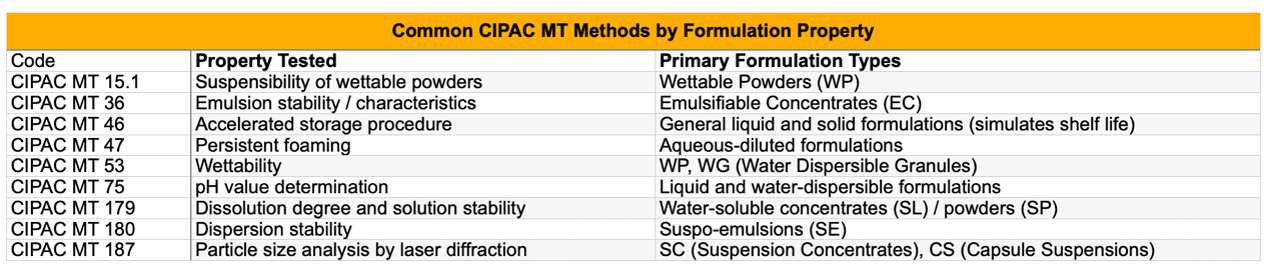
International tools already exist. CIPAC has long played a central role in standardizing analytical and physical testing methods for pesticide formulations. Its methods underpin pesticide quality work used by regulators and international specification systems.
FAO/WHO pesticide specifications perform a related but different function. They establish product-specific quality reference points intended to strengthen confidence in pesticide purchase and use and facilitate trade. FAO notes that specifications can be used by authorities to determine whether marketed formulations correspond to registered products and as part of contracts of sale to give buyers greater assurance of expected quality.
The distinction matters. CIPAC provides common methods for measurement. Specifications provide reference points for judgment.
Neither is a universal commercial rating system. But they demonstrate that formulation quality does not have to remain a vague claim such as “premium quality.”
It can be supported by evidence. From Laboratory Evidence to Commercial Language
That creates an opportunity for both suppliers and buyers. The objective is not to require an 18-parameter laboratory report with every purchase. It is to make credible evidence of formulation quality and consistency a more meaningful part of procurement. That could include clearer specifications, appropriate standardized testing, stronger batch-release documentation, traceability, complaint investigation and credible procedures for dealing with products that fail to meet requirements.
FAO’s International Code of Conduct reflects the underlying principle: technical and formulated pesticide products should conform to applicable standards or relevant specifications, while marketed products should correspond in identity, quality, purity and composition to the products that were evaluated and registered.
In other words, the industry does not simply need more testing. It needs better quality visibility.
For suppliers, that means making credible quality evidence easier to understand and trust.
For distributors and other buyers, it means giving meaningful quality differences greater weight in purchasing decisions.
That changes the conversation from simply: “What is your price?” to: “How consistently does this formulation meet its specification — and how can I verify that?”
Better Visibility Can Improve Competition
Greater quality visibility should not be viewed primarily as another burden on China’s strongest manufacturers. It could benefit them most.
If one producer invests in formulation science, tighter process control and stronger quality governance while another competes primarily through price — but the market cannot easily distinguish between them—the better system may not receive the value it deserves.
Making meaningful quality differences easier to recognize changes that incentive. It gives stronger manufacturers another basis for differentiation. It gives distributors another tool for managing commercial and reputational risk. And it increases the likelihood that growers receive consistent products. The goal is therefore not to make quality the only competitive variable.
China’s future formulation competitiveness will still depend on manufacturing scale, cost, formulation science, registration, supply-chain responsiveness, digital capabilities and local market service. Quality belongs within that broader portfolio. But the market must be able to see the difference.
The Next Opportunity Is Recognition and Value Creation for Global Farmers
China has already proved that it can manufacture crop protection products at global scale. Its formulation exports are becoming increasingly important. Formulation products from China’s leading crop protection companies have reached quality levels comparable to those of multinational corporations. To safeguard the interests of farmers worldwide, we ought to place these “visibly high-quality formulations” in the prime shelf positions they deserve, instead of letting them be pushed into corners by low-priced alternatives.

The next opportunity is not simply to ship more finished products — or even simply to make better ones. It is to create a market in which better formulations are easier to identify, compare and reward which’s value can be transparently transfers to farmers’ beneficiary, like yield increasing, lower damage by low-quality products. Identification of high-quality formulations should not rely solely on routine inspections by regulatory authorities; it should serve as a critical decision-making factor for China supply managers at all crop protection distributors.
Get The Newsletter Today!