• 关于
  • 接触
  • 订阅
  • en_US
  • es_MX
  • zh_CN
  • pt_BR
Resilience is Becoming Agriculture’s Next Competitive Advantage - AgriBusiness Global
  • 订阅
  • 广告
  • 订阅
  • 广告
  • 农用化学品
    • 除草剂
    • 杀虫剂
    • 杀菌剂
    • 佐剂
    • 种子与性状
  • 农业科技
  • 可持续性
  • 生物农药
  • 植物健康
    • 生物刺激素
    • 微量营养素
    • 氮磷钾
  • 市场
    • 美洲
    • 亚洲
    • 欧洲
    • 非洲/中东
  • 活动
    • ABG 活动
  • 报告
立即订阅,获取最新农业综合企业趋势信息
赞助内容

提出者 农业生物组学

韧性正成为农业的下一个竞争优势

For decades, the global agricultural industry has focused on increasing maximal yield. Advances in genetics, crop protection, nutrition, mechanization, and agronomic practices have enabled farmers to produce more food than ever before. But as climate change accelerates, a new challenge is emerging across every agricultural region of the world: protecting crop performance from increasingly frequent and unpredictable abiotic stresses.

Agriculture has always depended on weather, but today growers are facing greater uncertainty than previous generations. More variable rainfall patterns, rising temperatures, extended dry periods, and more frequent extreme weather events are creating conditions that can significantly reduce crop productivity, even in highly advanced agricultural systems.

Among the many abiotic stresses affecting global crop production, drought remains one of the most significant. Water deficits can disrupt fundamental plant processes, reducing photosynthesis, nutrient uptake, biomass accumulation, reproductive development, and ultimately yield. Even relatively short periods of drought during critical growth stages can have lasting consequences for crop performance. As these events become more common and less predictable, resilience is rapidly emerging as one of the most valuable traits in modern agriculture.

Soybean production is particularly exposed to this challenge. As one of the world’s most important crops for food, feed, and renewable fuels, soybean plays a central role in global agricultural productivity. However, the crop is highly sensitive to water availability during key reproductive stages. A drought event occurring at the wrong time can significantly reduce pod setting, grain fill, and final yields, creating substantial economic impacts throughout the value chain.

Few countries illustrate this challenge more clearly than Brazil. As the world’s largest soybean producer and exporter, Brazil has become a cornerstone of global food security. At the same time, its production systems are becoming increasingly exposed to climate variability. In recent years, producers across several soybean-growing regions have experienced recurring episodes of irregular rainfall, extended dry periods, and heat stress that directly affect crop performance. While advances in agronomy and genetics continue to drive productivity gains, environmental stress is becoming one of the primary factors limiting consistent crop performance and yield.

This reality is driving an important shift across agriculture. The industry can no longer focus exclusively on enabling crops to achieve higher yields under ideal conditions. Increasingly, growers need technologies that help preserve yield potential when conditions are less than ideal. Beyond the agronomic impact, climate-driven yield volatility is creating significant economic uncertainty for growers. Unpredictable production makes it more difficult to plan investments, manage cash flow, and achieve consistent returns. In today’s environment, many growers place greater value on stable and reliable yields year after year than on achieving a record harvest followed by several disappointing seasons. Resilience is therefore becoming more than an agronomic objective; it is a business strategy that helps improve profitability, reduce risk, and support long-term farm sustainability. As adaptation to environmental stress is a strategic priority, biological solutions are evolving from supportive inputs into critical tools for climate adaptation.

At Agrobiomics, we believe this shift represents one of the most important innovation opportunities in agriculture today.

Our mission is to pioneer resilient agriculture through the development of precise, science-backed biostimulants that help crops better cope with abiotic stress. This approach aims to elevate biologicals from broad-spectrum inputs to strategic technologies capable of delivering measurable value where growers need it most.

One of the most advanced examples of this work is Resilya®, an innovative soybean solution currently under development for initial launch in the Brazilian market. Designed to help crops better cope with abiotic stresses, particularly drought, Resilya® is being developed with a simple but powerful principle in mind: resilience should begin at the very start of the season.

For this reason, Agrobiomics initial commercial strategy focuses on seed treatment. By supporting the crop from the earliest stages of establishment, Resilya® aims to help soybean plants build resilience from day one, preparing them to better withstand environmental challenges throughout the growing cycle. Seed-applied solutions also offer a practical advantage, allowing growers to integrate resilience into their existing management programs without adding operational complexity.

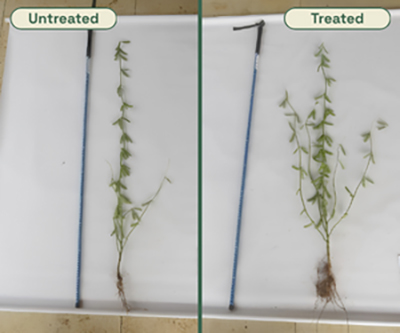
Soybean trials conducted with external research centers during the 2025-2026 season across ten locations in seven Brazilian states demonstrated strong performance. Applied as seed treatment, Resilya® delivered an average yield increase of more than 6% compared to the untreated control, equivalent to an average gain of 300kg/ha.

Comparison of soybean plants untreated and treated with Resilya®. Trial performed in Leme-SP, Brazil; season 2025-2026.

At the same time, Agrobiomics is also evaluating additional application approaches, including foliar applications and integrated programs combining seed treatment with a subsequent foliar application. These evaluations help us better understand how resilience can be supported throughout the crop cycle and under different environmental conditions. While seed treatment is expected to be the first route to market, the broader development program reflects our commitment to maximizing flexibility and value for future partners and growers.

The need for resilience technologies will only grow in the years ahead. Climate projections indicate that agricultural systems around the world will continue to experience increasing environmental variability. In this context, the future of crop productivity will be defined by how well crops can maintain performance when conditions become challenging.

In a world where environmental uncertainty is becoming the norm, resilience is agriculture’s next competitive advantage and a fundamental pillar of sustainable agricultural productivity. With a planned launch in 2027, Brazilian soybean growers may soon have access to a new generation of biostimulant technology designed specifically for this new reality. Through innovations such as Resilya®, Agrobiomics is working to help farmers better protect yield potential, reduce climate-related risk, and build more resilient production systems.

最新消息

生物农药

先正达与阿莫巴公司达成欧洲独家经销协议,旨在为谷物种植者带来突破性的生物杀菌剂。

作者: 先正达 | 阿米巴|2026年九月9日
这项独家协议将涵盖整个谷物市场…….
农用化学品

科迪华与格洛巴赫姆成立合资企业,推进新型配方作物保护溶液的开发和商业化。

作者: 科迪华 | 全球化工|2026年九月9日
合作支持新产品的开发和交付…….
杀菌剂

Belchim USA公司推出BELGUARD EQ杀菌剂,进一步丰富其产品组合。

作者: 美国贝尔奇姆|2026年九月9日
BELGUARD EQ 提供两种互补杀菌剂的预混液…….
ABG 更新功能

突破性生物杀菌剂的推出助力科尼全球扩张

作者: 莱昂纳多·戈特姆斯|2026年九月9日
Cogny公司新推出的基于代谢物的生物杀菌剂标志着巴西在生物防治领域的雄心壮志,并推动了…….

AgriBusiness Global

  • 接触
  • 关于
  • 咨询委员会
  • 广告
  • 订阅
  • 使用条款
  • 隐私政策
  • 转载权限
  • 取件须知
  • 您的隐私选择
  • 迈斯特传媒全球
  • Meister 定制业务解决方案

© 2026 迈斯特媒体全球