• 关于
  • 接触
  • 订阅
  • en_US
  • es_MX
  • zh_CN
  • pt_BR
Can you really achieve more with less? - AgriBusiness Global
  • 订阅
  • 广告
  • 订阅
  • 广告
  • 农用化学品
    • 除草剂
    • 杀虫剂
    • 杀菌剂
    • 佐剂
    • 种子与性状
  • 农业科技
  • 可持续性
  • 生物农药
  • 植物健康
    • 生物刺激素
    • 微量营养素
    • 氮磷钾
  • 市场
    • 美洲
    • 亚洲
    • 欧洲
    • 非洲/中东
  • 活动
    • ABG 活动
  • 报告
全球农业贸易峰会 | 2026年8月5-6日 | 内华达州拉斯维加斯
赞助内容

提出者 昆虫科学

真的可以用更少的资源获得更多成果吗?

The science behind Insect Science’s RPM® slogan

“Achieving more with less” is the kind of phrase that risks sounding aspirational rather than achievable. In pest management, however, and particularly in the control of false codling moth, it turns out to be both literal and measurable.

For growers and industry alike, efficiency is not a philosophical preference; it is an operational necessity. The central question is simple: what is the minimum amount of pheromone needed to achieve reliable, high-level control at the lowest possible cost? Answering it requires more than knowing that mating disruption works. It requires understanding how it works.

When Dr Vernon Steyn began his postgraduate research, it was already clear that mating disruption was an effective tool against false codling moth (FCM; Thaumatotibia leucotreta). What remained unclear was the mechanism behind that success. Moths were being disrupted, but it remained unclear whether males were being drawn away from females by pheromone dispensers acting as competitors, or whether high pheromone levels were overwhelming their ability to find a mate altogether. That gap in understanding became the foundation of his doctoral work. Read the full research paper 这里。

Following the moths

Dr Steyn’s research set out to examine mating disruption not as a product, but as a behavioural process. Using an extensive series of 48 mark-release-recapture field experiments with sterile moths, he measured male response across a wide gradient of pheromone dosages and release-site densities in both stone fruit orchards and table grape vineyards.

By applying a rigorous analytical framework developed by Miller and colleagues, the study distinguished between two fundamentally different modes of disruption: competitive and non-competitive. The results were both elegant and practical.

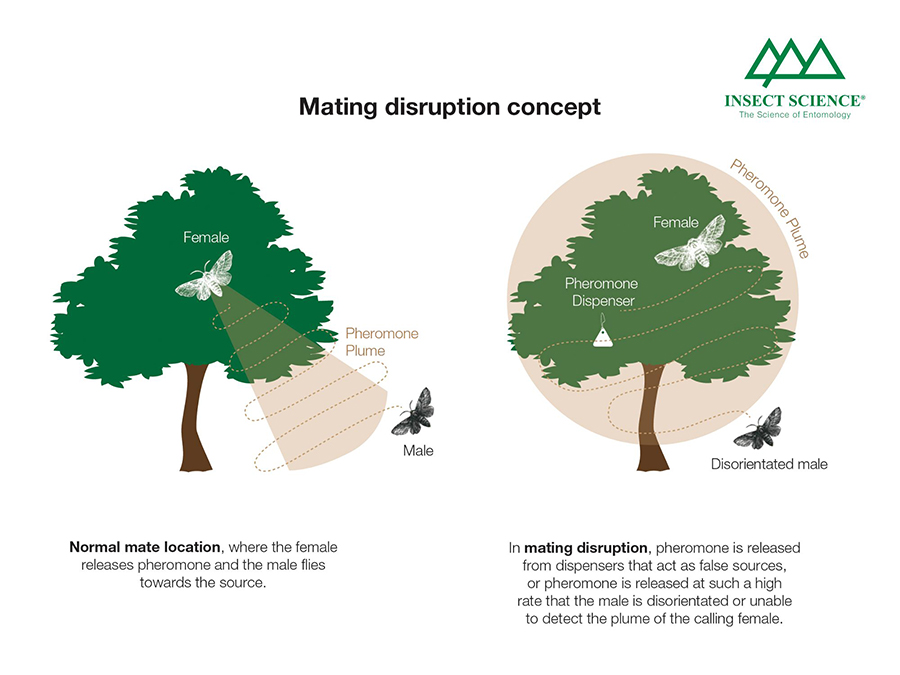
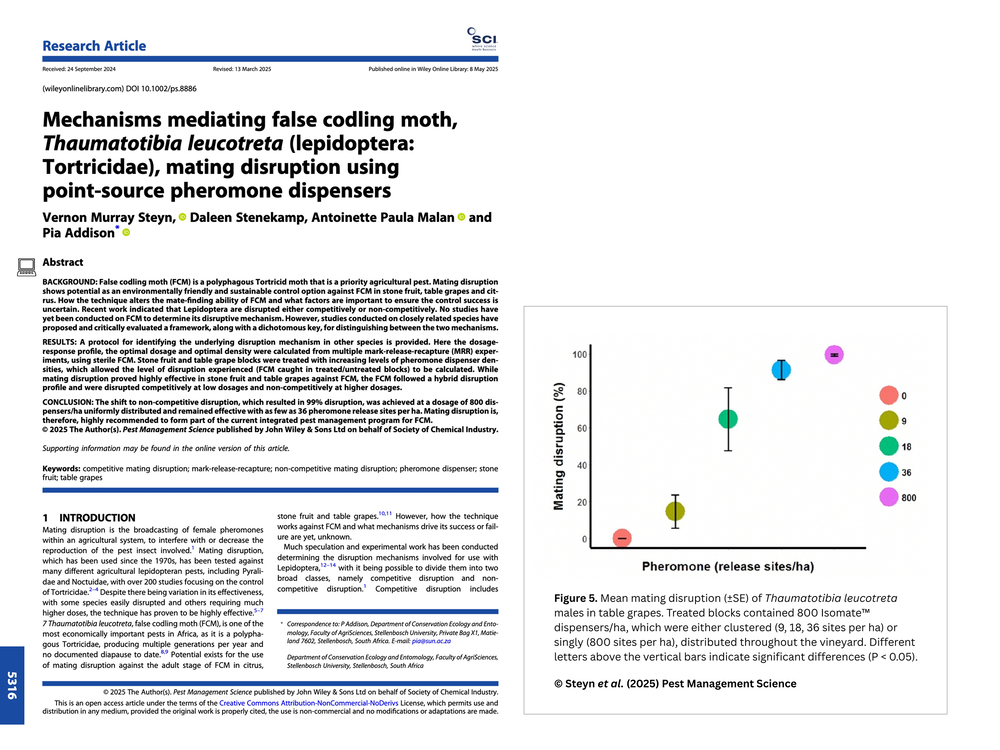
At lower pheromone dosages (up to about 600 dispensers per hectare), FCM males were disrupted competitively. Dispensers competed with calling females, leading males astray. The effect was real but limited: each additional dispenser delivered a smaller benefit than the last. At higher dosages, however, something changed.

At 800 dispensers per hectare, mating disruption increased sharply, reaching up to 99% reduction in male trap catch. Beyond this point, adding more dispensers made little difference. The moths were no longer merely confused; they were functionally unable to locate mates at all. The disruption had become non-competitive. Even more striking was what followed.

Fewer points, same power

When the same pheromone dose was delivered through fewer release points (clustered into as few as 36 sites per hectare) the disruption remained just as effective. This confirmed that the effect was not dependent on dense, uniform coverage. The mechanism itself had shifted.

This finding carries profound implications. Non-competitive disruption is largely independent of pest density, more tolerant of gaps, and far more resilient under high-pressure conditions. It is also, crucially, where “more with less” stops being a slogan and starts becoming a strategy.

A parallel path in the field

At the same time that Dr Steyn was pursuing these conclusions through formal doctoral research, Insect Science was independently observing the same pattern in commercial agriculture field trials. Across multiple production systems, field data began pointing toward the same outcome: Once a critical pheromone threshold was reached, control improved disproportionately and remained stable even as dispenser density was reduced. This convergence, academic and applied, experimental and operational, would later prove significant.

In 2019, Dr Steyn joined Insect Science as Senior Field Scientist. By 2020, he had been appointed Head of Research and Development, and in 2023, he assumed the role of Managing Director. During the interview process, it became apparent that the company’s own field-based work had been pointing in the same direction as his doctoral research. Approaching the problem from different angles, both had arrived at the same conclusion: effective control did not require more inputs, only a better understanding. It was a moment of rare alignment. The science met the field, and the field confirmed the science.

That serendipitous convergence gave language to an idea already taking shape within the company: Achieving More With Less. Not as a marketing flourish, but as a principle rooted in evidence, one that would come to underpin Insect Science’s Responsible Pest Management™ (RPM) philosophy.

At its core, RPM reflects a simple conviction: that genuinely effective pest control is only possible when products are developed with scientific rigour, biological insight, and respect for system-wide consequences. Innovation, in this sense, is not about adding complexity but about removing inefficiency.

By grounding product development in mechanism rather than assumption, Insect Science continues to pursue solutions that are not only effective, but precise – designed to do exactly what is needed, and no more.

Why mechanism matters

The distinction between competitive and non-competitive mating disruption is not an academic nuance. It determines whether a control programme is poor or robust. Competitive disruption requires high dispenser densities, uniform deployment, and relatively low pest pressure. It works, until it doesn’t.

Non-competitive disruption, by contrast, suppresses mate-finding behaviour at a sensory level. Its effectiveness does not erode as populations rise. It allows for fewer release sites, clustered deployment, and intentional gaps without sacrificing control. Dr Steyn’s work provides the first clear evidence that FCM can be pushed from one mode into the other using commercially available dispensers at realistic field rates.

In the end, the story of achieving more with less is not about reducing inputs but about increasing understanding. What began as a scientific question (how mating disruption actually works in FCM) became a point of convergence between research and practice. Dr Steyn’s work showed that when pheromones are applied with precision, the mechanism itself shifts, delivering stronger, more resilient control without proportional increases in effort or cost. At the same time, Insect Science’s field experience was pointing to the same conclusion, reached not in theory, but in orchards and vineyards under real-world pressure. That alignment gave form to a philosophy. Responsible Pest Management™ is about designing solutions that do exactly what is needed, and no more. In that precision lies both effectiveness and responsibility, and the understated proof that, sometimes, less truly is more.

昆虫科学 is a leading agricultural biotechnology company based in South Africa, developing and manufacturing semiochemical-based pest management solutions for sustainable agriculture.

更多来自这个赞助商

半化学物质在现代综合虫害管理中的前沿作用

赞助: 昆虫科学

最新消息

ABG 更新功能

全球农业综合企业报告:人工智能如何革新农业综合企业

作者: 莎拉·韦伯|2026年七月17日
在本期《全球农业商业报告》中,斯坦…….
除草剂

先正达起诉巴斯夫侵犯其美国除草剂专利

作者: 路透社的数据,|2026年七月16日
诉讼称巴斯夫公司的新型玉米除草剂Ridivex侵犯了…….
除草剂

UPL推出Ricebeaux,一款用于水稻种植的智能杂草管理解决方案

作者: UPL有限公司|2026年七月16日
水稻早期除草剂可有效控制多种杂草…….
ABG 更新功能

非洲综合虫害管理:作物保护公司为支持种植者必须做出的5项战略转变

作者: 莎拉·韦伯|2026年七月15日
探索不断发展的出口标准、生物创新、管理以及…….

AgriBusiness Global

  • 接触
  • 关于
  • 咨询委员会
  • 广告
  • 订阅
  • 使用条款
  • 隐私政策
  • 转载权限
  • 取件须知
  • 您的隐私选择
  • 迈斯特传媒全球
  • Meister 定制业务解决方案

© 2026 迈斯特媒体全球