The Future of Biologicals Formulation
 13 May 2026
 Across the agricultural value chain, artificial intelligence (AI) is rapidly reshaping how biological products are discovered, developed, and brought to market, enabling companies to deliver products with greater consistency and relevance for farmers.
From Data to Discovery
Traditional biological R&D has relied heavily on empirical screening and field trials — a process that can take years and millions of dollars in investment.
Now, AI is helping make discoveries faster and smarter.
In one notable example, Syngenta Seeds partnered with AI specialist InstaDeep to accelerate trait development by applying large language models trained on massive genomic datasets.
For Syngenta, this partnership turned raw biological information into actionable insights to accelerate discovery timelines.


AI-Powered Microbial R&D and Validation
AI’s research role also extends into microbial discovery and optimization.
Consider the acquisition of Lavie Bio by ICL. Lavie Bio’s proprietary MicroBoost AI platform uses machine learning and advanced computation to accelerate the identification and optimization of microbial candidates for biostimulants and biopesticides.
ICL VP of R&D Dr. Elinor Erez says integrating Lavie Bio’s AI platform with ICL’s R&D and field teams will advance sustainability at scale. Further illustrating AI’s impact, the ICL–Lavie Bio program has already identified more than a dozen novel microbe candidates believed to have commercial promise. These were computationally selected for efficacy, stability, and compatibility with fertilizers — all before extended field testing — accelerating candidate prioritization and reducing uncertainty.
Beyond Discovery: Formulation, Prediction, and Deployment
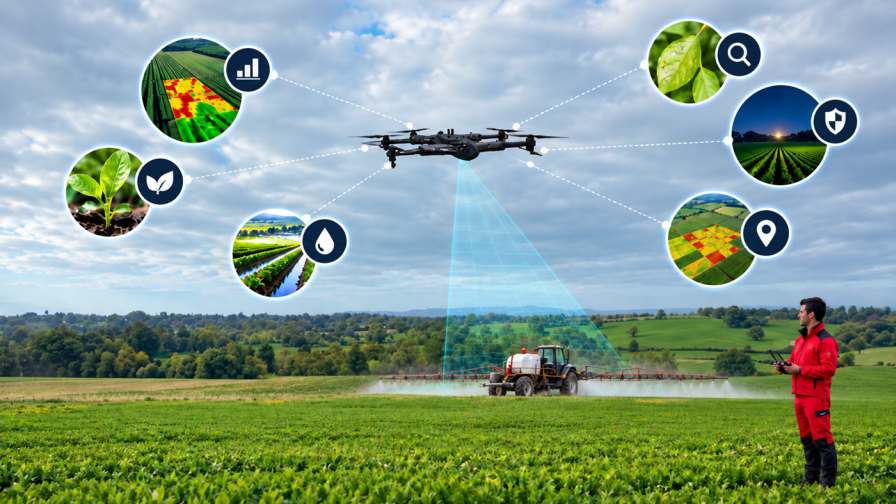
Machine learning models integrating large environmental and soil datasets to forecast where and when certain biologicals will perform best is helping biological companies market products.
Agronomists and growers are able to make data-driven decisions on application timing, placement, and complementary inputs — an increasingly important capability as weather extremes and environmental variability challenge traditional timing strategies.
These predictive capabilities are complemented by AI-guided screening for formulation performance, encapsulation effectiveness, and controlled release, addressing common pain points such as short product shelf life and inconsistent field responses.
A leading example is the Syngenta-TraitSeq partnership, which leverages TraitSeq’s machine‑learning platform to analyze complex biological big data and uncover predictive molecular biomarkers — highly specific indicators of a plant’s cellular state that signal responses to biostimulants.
In a statement about the partnership, Syngenta Head of Crop Protection Research and Development Camilla Corsi said the collaboration is meant to “revolutionize our research and attain important data‑driven insights,” helping to “develop the next‑generation of sustainable solutions faster” and strengthen Syngenta’s pipeline of innovative agricultural technologies.
TraitSeq’s proprietary approach combines machine learning, transcriptome analysis, and RNA‑Seq data to predict how biological inputs influence plant performance, enabling researchers to prioritize the most promising biostimulant candidates and evaluate their potential more quickly and accurately.
In the same statement, Dr. Joshua Colmer, CEO of TraitSeq, said how a “platform can transform agricultural input development by uncovering predictive biomarkers that directly link molecular insights to biostimulant performance,” which, in turn, aims to support farmers’ adoption of more sustainable practices through more predictable biological products.
Market Momentum and Commercial Impacts
The commercial implications of AI integration in biologicals are significant.
AI accelerates time-to-market by reducing the number of developmental cycles needed to identify promising candidates and refine formulations. For companies competing in an increasingly crowded biologicals field, speed and predictability translate into competitive advantage.
Moreover, performance consistency — once a major concern among growers — is improving. Predictive modeling and advanced analytics reduce the performance variability that historically slowed adoption. This, in turn, helps biological products fit more seamlessly into broader crop management strategies rather than being treated as “experimental” extras.
AI’s role in product validation and demonstration also supports regulatory compliance. By centralizing and standardizing data outputs, AI platforms can help generate the evidence packages regulators increasingly expect for efficacy and safety claims.
Ongoing Challenges and the Path Forward
Despite AI’s promise, challenges remain. Biological systems are intricate, and computational predictions still require rigorous field validation.
Data standardization across genomics, metabolomics, phenomics, and environmental sources is a technical barrier. Transparency in AI-derived insights is critical for regulatory and grower confidence.
By making discovery more efficient, performance more predictable, and deployment more precise, AI is helping biological products evolve from niche alternatives to reliable components of integrated crop management. As AI systems and biological datasets grow, the line between biological innovation and digital intelligence will continue to drive both productivity and sustainability.
Read more articles like this one in AgriBusiness Global’s 2026 Biologicals Deep Dive.
Get The Newsletter Today!