How Important Is Technology Transfer in Agriculture?
Adoption of a new product by growers begins with identifying a problem and offering a solution. Advancing discoveries into commercially viable products is just one step toward successful market adoption. Disciplined scientific rigor supporting savvy business and go-to-market strategies is also crucial. The development phase within research and development is as much about process as it is about science.
While soil-plant biochemistry is extremely complex, growers have practical experience documenting variability and productivity in their operations. When considering a new product, the growers expect proof about how it will improve the production and profitability of their operation. It sounds simple, but barriers to adoption are as complex as the soil-plant biochemistry.
Proven Best Management Practices is Critical
Generally, best management practices are site-specific production methods that ensure safe, high-quality products, animals and plants while preserving the environment and social acceptance. Decisions to change production methods involve many factors from perceived advantages and application simplicity to compatibility with existing practices. Evaluating the known verses the unknown can cause fear or anxiety related to trust in the new product, effort required to change, and potential negative feedback from peers or the community. The psychology of change can be a crucial barrier to overcome.
Overcoming that barrier requires understanding current practices that are site-specific to the growing environment and growers’ attitudes about peer pressure, trusted advisor recommendations, and needs for economic security or reduced risk.
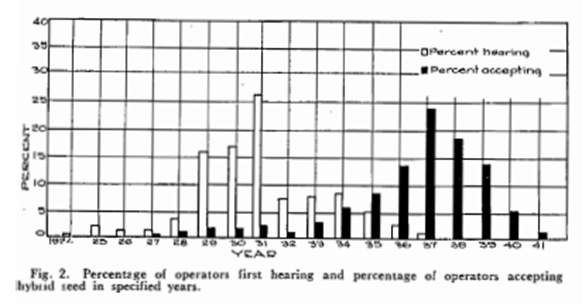
Much has been explored about adoption of products and practices since the important technical innovation of hybrid corn. An Iowa State research bulletin published in 1950 by Bryce Ryan and Neal Gross established the conditions and process for adoption of hybrid corn in Iowa counties. It’s an example of how timing (acceptance within one decade), information sharing, and the personal, economic and social characteristics of farm operators influence new product adoption.


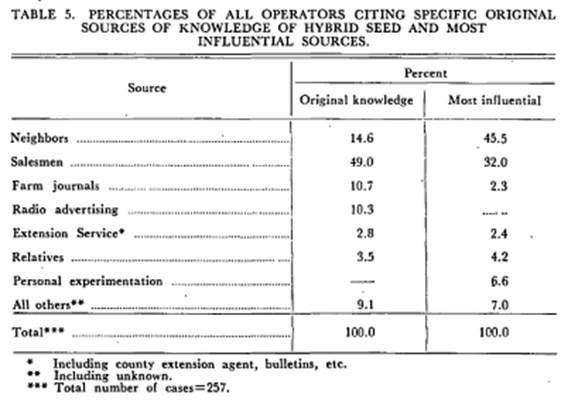
This study of technological innovation adoption noted that both leaders (or early adopters) and laggards made up about 16% of all farmers in their acceptance of hybrid corn. According to the study, the early adopters performed the role of “experimenters” in their communities. The adoption process for all began in small quantities for trial use. The major single source of first knowledge about the hybrid seed corn was salesmen. They were informants and influencers in the early period, but the most influential single source was “neighbors.”
The early adopters were comparable in size of farm enterprise, education, youthfulness and extent of social participation. Community leadership was not related to leadership in adoption of the new technology. However, the economic depression and intermittent drought of these years impacted the spread of the hybrid seed. Under economic stress, producers were searching for efficient production techniques.
Hybrid corn required cash outlay compared to the common practice of planting the “saved seed” from previous season. The depressed farm economy and drought of the 1930s both slowed hybrid seed adoption. This economic uncertainty also affected the production of hybrid seed itself, but most Iowa farmers eventually adopted the new hybrid technology within the decade.
Note the timelapse from first hearing about the new technology to acceptance over the 10-year period:
Knowledge is Key
So how does this historical reference relate to new technologies of the current decade? The spread of knowledge precedes adoption. In today’s world the speed of information remains faster than adoption, and the impact of influencers is strong at the beginning of awareness and diminishes as the growers gain experience through trials of their own.
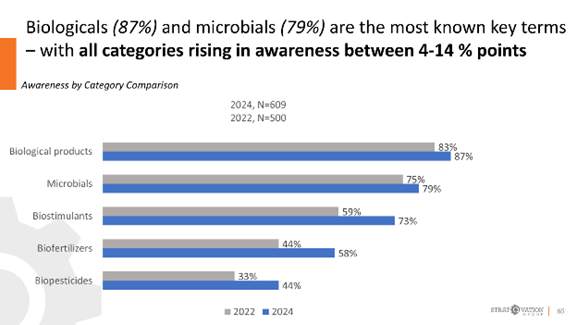
Much like growing awareness of hybrid seed corn, that’s especially true in today’s crop biologicals sector. The knowledge and use of products like biostimulants is seeing a steady increase in recent years, according to research conducted by Stratovation Group. Data since 2022 shows especially large gains in general product awareness, especially for biostimulants, biofertilizers and biopesticides.
It’s a sign that those influencers cited nearly a century ago relating to hybrid corn remain just as important to raising awareness and ultimately, purchase and use of biologicals much like the early hybrids that marked the start of a massive step forward in row crop agriculture.
Local Champions are Impactful
Engaging and convincing key opinion leaders — critical influencers of the early adopters — is a key step. These influencers not only can introduce new technologies and spread information, but also often are unselling the new to continue traditional practices. Critical factors include motivations of sales teams working to meet company goals and margins on specific products. The sales incentives through the supply chain contribute to either the demise or adoption of new products. Grower demand must overcome many barriers to change.
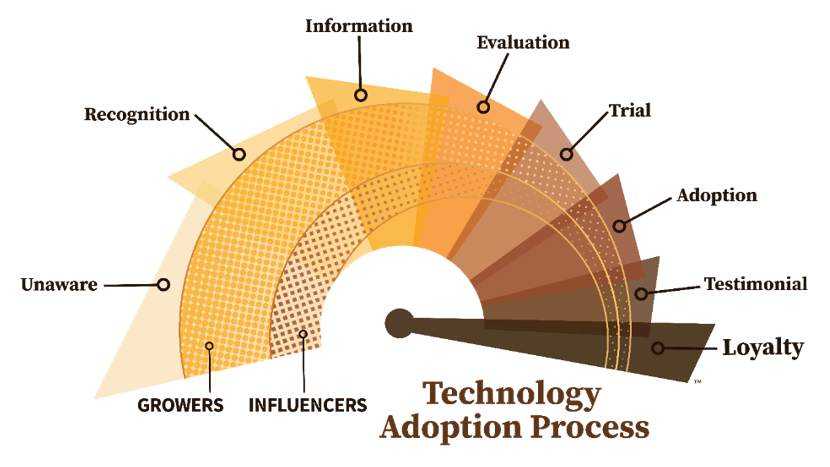
Engaging the right influencers — starting with neighbors and other trusted advisors — can help generate awareness of such products, ultimately leading to adoption on farms, but only if the entire value chain sees benefits. The most dominant detractor or enabler of any ag innovation is the retailer who often is considered a “trusted advisor” by the growers despite their mixed motivations of employer incentives and their grower-customer loyalty. Knowledge about benefits of new product use and incentives must be aligned from the input manufacturer through the retail channels to the growers themselves.
Grower Motivations Go Beyond ROI
Another part of this adoption chain is the psychology of the grower who is much like a consumer and not always motivated by the cost/benefit. The psychological factors of innovation adoption are more complex than simply build awareness and prove return on investment.
Behavioral scientists document the decision-making process of innovators that involves many factors starting from compatibility with existing practices, complexity of use, testability for observable benefits, to perceived advantages. Personal attributes further the complexity with attitudes of the grower—their openness, interest or concerns, their emotional reactions of fear or anxiety about change, their trust in the innovation or those introducing it, their perceived effort required, and even their social reactions to peers and their community. Overcoming many psychological, physical and financial barriers is paramount for successful innovation adoption.
Steps to consider for effective technology transfer:
- Establish existing practices and potential for compatibility or disruption in the current production system.
- Consolidate and build on scientific evidence and field experiences supporting the use and financial benefits of new products in Best Management Practice system approach.
- Identify champions in the influencer community, consolidate supporting opinions and raise awareness of the Best Management Practice recommendations based on scientific data and performance.
- Educate all key audiences to reinforce best practices incorporating key products into successful crop production system.
- Local testing and training throughout the sales channel and influencer community is a continual process to prove benefits and keep use top-of-mind beyond the launch. Successful products continue this process throughout the life of the product.
Though cost concerns and return on investment must be addressed in justifying the addition of new products like crop biologicals, demonstrating their value via trusted voices solidifies the position and usefulness, ultimately making them as common as hybrid seed corn on today’s progressive row crop farms.
The evolutionary nature of products like hybrid seed corn and crop biologicals ultimately usher in massive change for farming practices that enhance efficiency, safety and profitability at the farm gate and lead to more resilient, sustainable food, feed, fiber and renewable fuel production.
Get The Newsletter Today!