• 关于
  • 接触
  • 订阅
  • en_US
  • es_MX
  • zh_CN
  • pt_BR
New Sun Validates Botanical Biocontrol in Brazil Coffee Trials - AgriBusiness Global
  • 订阅
  • 广告
  • 订阅
  • 广告
  • 农用化学品
    • 除草剂
    • 杀虫剂
    • 杀菌剂
    • 佐剂
    • 种子与性状
  • 农业科技
  • 可持续性
  • 生物农药
  • 植物健康
    • 生物刺激素
    • 微量营养素
    • 氮磷钾
  • 市场
    • 美洲
    • 亚洲
    • 欧洲
    • 非洲/中东
  • 活动
    • ABG 活动
  • 报告
全球农业贸易峰会 | 2026年8月5-6日 | 内华达州拉斯维加斯
赞助内容

提出者 成都新闻

New Sun Validates Botanical Biocontrol in Brazil Coffee Trials

For coffee growers, bacterial disease can become a much bigger problem when mild temperatures, frequent rain and strong winds arrive together. Coffee bacterial halo blight, caused by Pseudomonas syringae pv. garcae, is one of the most important bacterial diseases affecting coffee in Brazil. It is especially associated with high-altitude, cool and humid production areas exposed to persistent winds, and published research has reported severe losses under highly favorable conditions. The disease can damage leaves, young fruits and growing branches, causing the characteristic dark lesions surrounded by yellow halos, defoliation and branch dieback.

The disease is particularly relevant because it occurs in major Brazilian coffee regions, including Minas Gerais, São Paulo and Paraná. Management is not always straightforward: genetic resistance remains limited, while disease pressure changes sharply with location, weather and crop condition. For growers and crop-protection suppliers, that creates a clear need for additional tools that can complement existing programs rather than simply add another conventional chemistry.

Why Botanical Biopesticides Need More Than Natural Activity

Botanical biopesticides are increasingly being considered as part of integrated pest management (IPM), where biological and conventional tools are used together to broaden modes of action, support resistance management and reduce dependence on any single control approach. But the commercial challenge with plant-derived products is not a lack of promising plants. It is consistency.

Natural extracts are chemically complex, and their performance can be influenced by plant genetics, growing conditions, harvest timing, raw-material quality and processing. A plant may show strong biological activity in one extract and much weaker performance in another. For botanical crop protection to earn a permanent place in modern agriculture, that natural complexity has to be translated into products that are standardized, reproducible and scalable.

This has been a long-term focus for New Sun. Drawing on China’s unusually broad access to medicinal and functional plant resources, the company has built an extensive botanical resource library to support the discovery and screening of new plant-derived crop-protection solutions. New Sun’s goal is not simply to identify more extracts, but to advance the standardization of botanical biopesticides and make them practical tools for modern IPM.

To support this work, New Sun developed the PLTAMCC platform, a technology pathway for identifying, enriching and controlling functional molecular clusters from plant materials. Rather than reducing a botanical extract to a single isolated molecule, PLTAMCC is designed to retain the molecular groups responsible for the target biological function while creating a repeatable route from raw material to formulation. This can also preserve complementary biological functions within the extract, including effects that support plant health or productive performance.

More than 20 biopesticide products have already been developed through the platform and related botanical R&D programs, and New Sun plans to continue expanding the portfolio across different crops, pests and diseases.

Garlic Bulb Extract (Dati-Allin): From Botanical Resource to Field Solution

One of the products emerging from this approach is Garlic Bulb Extract (Dati-Allin), developed for bacterial disease management. Garlic has long been recognized for antimicrobial activity, but turning that natural activity into a dependable agricultural product requires much more than simply producing an extract.

In Dati-Allin, allicin is used as a marker compound for Garlic Bulb Extract, while the product retains a broader spectrum of sulfur-containing bioactive molecules. New Sun’s research indicates that these compounds can act through multiple antibacterial mechanisms, including inhibition of key bacterial enzymes and disruption of bacterial cell membranes and cell walls. The plant-derived chemistry also offers rapid degradation and low residue potential, characteristics that make it particularly relevant as a biological disease-management tool.

The important question, however, is not whether garlic can inhibit bacteria in a laboratory. It is whether a standardized garlic-derived product can perform under real field conditions, where disease pressure, cultivar, crop age and weather all change from site to site.

Putting Dati-Allin to the Test in Brazilian Coffee

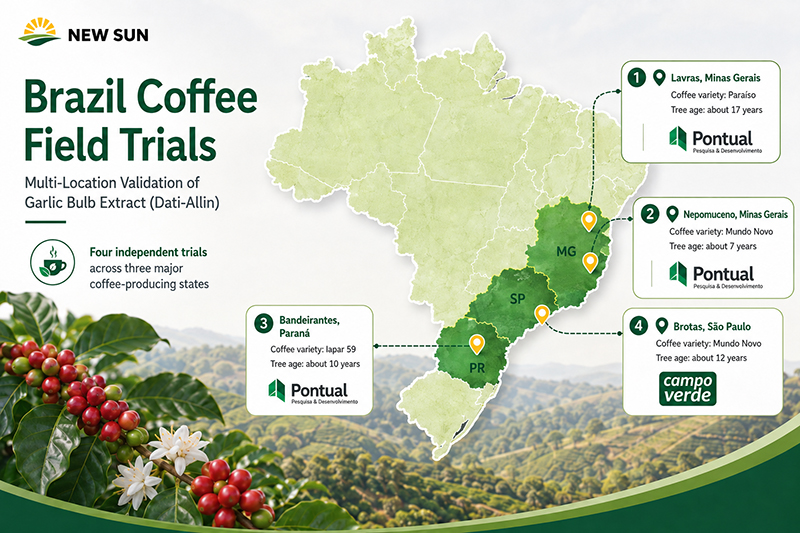
During the 2025–2026 season, Garlic Bulb Extract (Dati-Allin) was evaluated against coffee bacterial halo blight in four independent field trials across Brazil. The trials were conducted in Lavras and Nepomuceno in Minas Gerais, Bandeirantes in Paraná, and Brotas in São Paulo. They covered different coffee varieties and tree ages, with three trials conducted by Pontual Pesquisa and one by Campo Verde.

Four independent coffee field trials in Brazil: Lavras, Nepomuceno, Bandeirantes and Brotas.

The four trials did not produce identical numbers—and that is precisely why the data are useful. Disease pressure and environmental conditions varied by location, but one pattern kept returning: the 1,000–1,500 mL/ha range consistently ranked among the strongest Dati-Allin treatments.

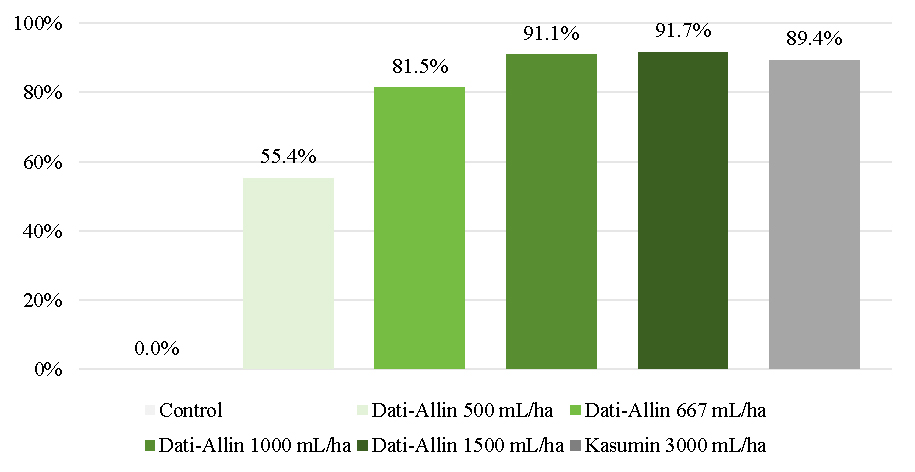
Lavras delivered the most striking result. At 1,000 and 1,500 mL/ha, control of disease incidence reached 91.1% and 91.7%, respectively. For disease severity, control reached 91.8% at 1,000 mL/ha and 91.1% at 1,500 mL/ha. These values were numerically comparable with the kasugamycin reference treatment used in the trial.

The absolute efficacy was lower in the other locations, reflecting different disease environments, but the same rate range remained the most consistent. In Nepomuceno, the 1,000 and 1,500 mL/ha treatments both delivered around 61.6% incidence control and significantly reduced disease severity. In Bandeirantes and Brotas, the higher Dati-Allin rates again remained among the best-performing treatments.

Representative disease-control results from the Brazil coffee trials.

For a biological product, this consistency across locations is as important as the highest single-site number. A field-ready botanical solution has to perform across different varieties, crop ages and disease pressures—not only under one favorable set of conditions.

Disease Control Without a Yield Penalty

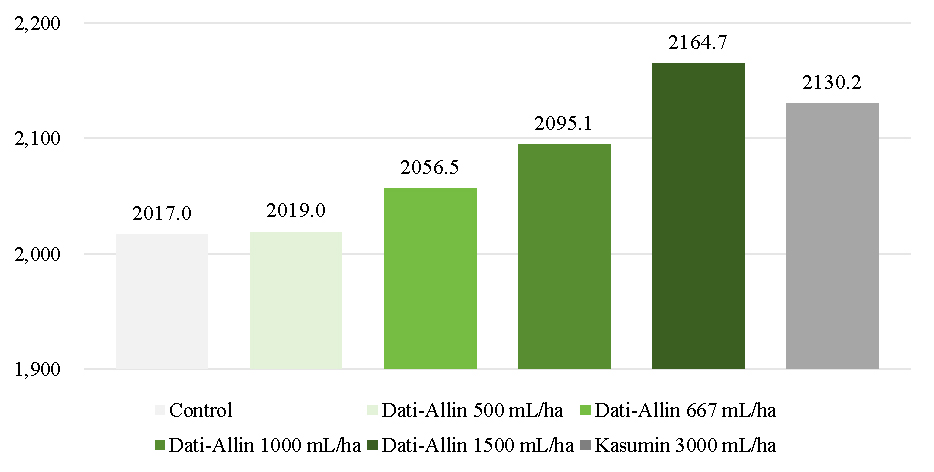
The second message from the trial network was equally important: disease control did not come at the expense of crop performance. No phytotoxicity was reported across the tested Dati-Allin rates. Productivity was maintained across the trials, and several Dati-Allin treatments showed positive numerical yield responses. In the Paraná trial, the 1,500 mL/ha treatment recorded a 7.3% increase over the untreated control.

This matters because plant-derived molecular clusters can contain more than compounds responsible for direct pathogen suppression. They may also retain complementary functions that support plant health, recovery or growth. For New Sun, that multifunctional potential is one reason to work with standardized molecular clusters rather than focusing only on a single isolated molecule.

Yield response of Garlic Bulb Extract (Dati-Allin) in Bandeirantes, Paraná.

Building a Broader Botanical IPM Toolbox

New Sun does not see biological crop protection as a simple replacement story. Chemical pesticides remain essential when pest or disease pressure is high, while biological tools can play an important role in prevention, resistance management and long-term crop-protection strategies. The opportunity is to use both more intelligently within IPM.

For botanical biopesticides to contribute meaningfully, three capabilities need to come together: access to biological diversity, a standardized development pathway, and field validation. New Sun’s botanical resource library provides the discovery base. PLTAMCC provides a route for transforming complex plant chemistry into reproducible formulations. And multi-location programs such as the Brazil coffee trials provide the evidence needed to test whether that promise holds up in real agronomic conditions.

Garlic Bulb Extract (Dati-Allin) is one example of that pathway—from plant resource to standardized botanical formulation, and from laboratory bioactivity to multi-location field validation. With more than 20 biopesticide products already developed and a growing pipeline of plant-derived solutions, New Sun plans to continue expanding its botanical portfolio and advancing the standardization of plant-derived crop protection.

The long-term goal is straightforward: make botanical biopesticides reliable enough to become a practical, scalable part of modern IPM—and give growers more ways to protect crops, manage resistance and sustain productivity.

更多来自这个赞助商

成都新讯探讨生物刺激剂市场、机遇及其他

赞助: 成都新闻

专家问答:成都新日生物制药的陈廷卓博士谈生物制剂的定位及其作为可行工具的作用

赞助: 成都新闻

专利花粉多糖:品牌差异化的新途径

赞助: 成都新闻

最新消息

行业新闻

Vylor开启玉米新纪元:业内首创的产量和产量稳定性性状,以及先进的虫害控制技术,将带来产量和农民利润的飞跃式增长。

作者: 科迪华|2026 年 9 月 1 日
Vylor公司公布了一项变革性的玉米管道计划,该计划将持续到2035年,并承诺…….
ABG 更新功能

全球农业商业报告:非专利活性成分的未来

作者: 莎拉·韦伯|2026年八月28日
Tagros Chemicals 的 Abhijit Bose 探索了非专利活性成分、人工智能驱动的…….
ABG 更新功能

可持续发展播客:CPDA的Terry Kippley谈该组织的可持续发展工作

作者: 莎拉·韦伯|2026年八月27日
Terry Kippley 探讨了该组织在可持续发展方面所做的努力,以及 CPDA 的持续进展…….
生物农药

巴西:Bioma推出代谢保护型生物杀菌剂

作者: 生物群落|2026年八月27日
该生物杀菌剂已注册用于防治炭疽病…….

AgriBusiness Global

  • 接触
  • 关于
  • 咨询委员会
  • 广告
  • 订阅
  • 使用条款
  • 隐私政策
  • 转载权限
  • 取件须知
  • 您的隐私选择
  • 迈斯特传媒全球
  • Meister 定制业务解决方案

© 2026 迈斯特媒体全球