


New Sun valida el biocontrol botánico en ensayos de café en Brasil.
Para los caficultores, las enfermedades bacterianas pueden convertirse en un problema mucho mayor cuando coinciden temperaturas suaves, lluvias frecuentes y vientos fuertes. El halo bacteriano del café, causado por Pseudomonas syringae pv. garcae, es una de las enfermedades bacterianas más importantes que afectan al café en Brasil. Se asocia especialmente con zonas de producción de gran altitud, frescas y húmedas, expuestas a vientos persistentes, y estudios publicados han reportado pérdidas severas incluso en condiciones muy favorables. La enfermedad puede dañar las hojas, los frutos jóvenes y las ramas en crecimiento, causando las características lesiones oscuras rodeadas de halos amarillos, defoliación y muerte regresiva de las ramas.
Esta enfermedad es particularmente relevante porque afecta a importantes regiones cafetaleras brasileñas, como Minas Gerais, São Paulo y Paraná. Su manejo no siempre es sencillo: la resistencia genética es limitada, mientras que la presión de la enfermedad varía drásticamente según la ubicación, el clima y el estado del cultivo. Para los productores y los proveedores de productos fitosanitarios, esto genera una clara necesidad de herramientas adicionales que complementen los programas existentes, en lugar de simplemente añadir otro producto químico convencional.
Por qué los biopesticidas botánicos necesitan algo más que la actividad natural.
Los biopesticidas botánicos se consideran cada vez más como parte del manejo integrado de plagas (MIP), donde se utilizan conjuntamente herramientas biológicas y convencionales para ampliar los modos de acción, apoyar el manejo de la resistencia y reducir la dependencia de un único método de control. Sin embargo, el desafío comercial de los productos derivados de plantas no radica en la falta de plantas prometedoras, sino en la consistencia.
Los extractos naturales son químicamente complejos y su eficacia puede verse influenciada por la genética de la planta, las condiciones de cultivo, el momento de la cosecha, la calidad de la materia prima y el procesamiento. Una planta puede mostrar una fuerte actividad biológica en un extracto y una eficacia mucho menor en otro. Para que la protección botánica de cultivos se consolide en la agricultura moderna, esa complejidad natural debe traducirse en productos estandarizados, reproducibles y escalables.
Este ha sido un objetivo prioritario para New Sun desde hace mucho tiempo. Aprovechando el acceso excepcionalmente amplio de China a recursos vegetales medicinales y funcionales, la empresa ha creado una extensa biblioteca de recursos botánicos para apoyar el descubrimiento y la evaluación de nuevas soluciones fitosanitarias de origen vegetal. El objetivo de New Sun no es simplemente identificar más extractos, sino impulsar la estandarización de los biopesticidas botánicos y convertirlos en herramientas prácticas para el manejo integrado de plagas (MIP) moderno.
Para respaldar este trabajo, New Sun desarrolló la plataforma PLTAMCC, una tecnología que permite identificar, enriquecer y controlar grupos moleculares funcionales a partir de materiales vegetales. En lugar de reducir un extracto botánico a una sola molécula aislada, PLTAMCC está diseñada para conservar los grupos moleculares responsables de la función biológica deseada, creando un proceso reproducible desde la materia prima hasta la formulación. Esto también permite preservar funciones biológicas complementarias dentro del extracto, incluyendo efectos que favorecen la salud de la planta o su productividad.
Ya se han desarrollado más de 20 productos biopesticidas a través de la plataforma y los programas de I+D botánica relacionados, y New Sun planea seguir ampliando la cartera a diferentes cultivos, plagas y enfermedades.
Extracto de bulbo de ajo (Dati-Allin): Del recurso botánico a la solución de campo
Uno de los productos derivados de este enfoque es el extracto de bulbo de ajo (Dati-Allin), desarrollado para el control de enfermedades bacterianas. El ajo es conocido desde hace tiempo por su actividad antimicrobiana, pero convertir esa actividad natural en un producto agrícola fiable requiere mucho más que simplemente producir un extracto.
En Dati-Allin, la alicina se utiliza como compuesto marcador del extracto de bulbo de ajo, mientras que el producto conserva un espectro más amplio de moléculas bioactivas que contienen azufre. La investigación de New Sun indica que estos compuestos pueden actuar mediante múltiples mecanismos antibacterianos, incluyendo la inhibición de enzimas bacterianas clave y la alteración de las membranas y paredes celulares bacterianas. La química derivada de plantas también ofrece una rápida degradación y un bajo potencial de residuos, características que la hacen particularmente relevante como herramienta biológica para el manejo de enfermedades.
La cuestión importante, sin embargo, no es si el ajo puede inhibir las bacterias en un laboratorio, sino si un producto estandarizado derivado del ajo puede funcionar en condiciones reales de campo, donde la presión de las enfermedades, la variedad, la edad del cultivo y el clima varían de un lugar a otro.
Poniendo a prueba el Dati-Allin en el café brasileño.
Durante la temporada 2025-2026, se evaluó el extracto de bulbo de ajo (Dati-Allin) contra la mancha bacteriana del café en cuatro ensayos de campo independientes en todo Brasil. Los ensayos se realizaron en Lavras y Nepomuceno (Minas Gerais), Bandeirantes (Paraná) y Brotas (São Paulo). Se incluyeron diferentes variedades de café y edades de los árboles, con tres ensayos realizados por Pontual Pesquisa y uno por Campo Verde.
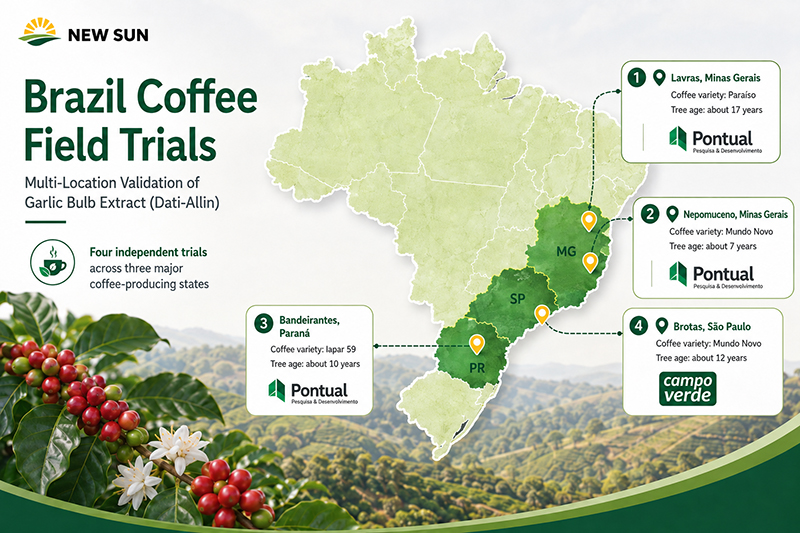
Cuatro ensayos independientes de campo de café en Brasil: Lavras, Nepomuceno, Bandeirantes y Brotas.
Los cuatro ensayos no arrojaron resultados idénticos, y precisamente por eso los datos son útiles. La presión de la enfermedad y las condiciones ambientales variaron según la ubicación, pero un patrón se repitió: el rango de 1000 a 1500 ml/ha se situó sistemáticamente entre los tratamientos con Dati-Allin más eficaces.
Lavras ofreció el resultado más notable. A dosis de 1000 y 1500 mL/ha, el control de la incidencia de la enfermedad alcanzó el 91,11% y el 91,71%, respectivamente. En cuanto a la gravedad de la enfermedad, el control alcanzó el 91,81% a 1000 mL/ha y el 91,11% a 1500 mL/ha. Estos valores fueron numéricamente comparables con el tratamiento de referencia con kasugamicina utilizado en el ensayo.
La eficacia absoluta fue menor en las demás localidades, lo que refleja diferentes entornos de enfermedad, pero el mismo rango de dosis se mantuvo como el más consistente. En Nepomuceno, los tratamientos de 1000 y 1500 mL/ha lograron un control de incidencia de alrededor del 61,61% y redujeron significativamente la gravedad de la enfermedad. En Bandeirantes y Brotas, las dosis más altas de Dati-Allin se mantuvieron nuevamente entre los tratamientos con mejor desempeño.
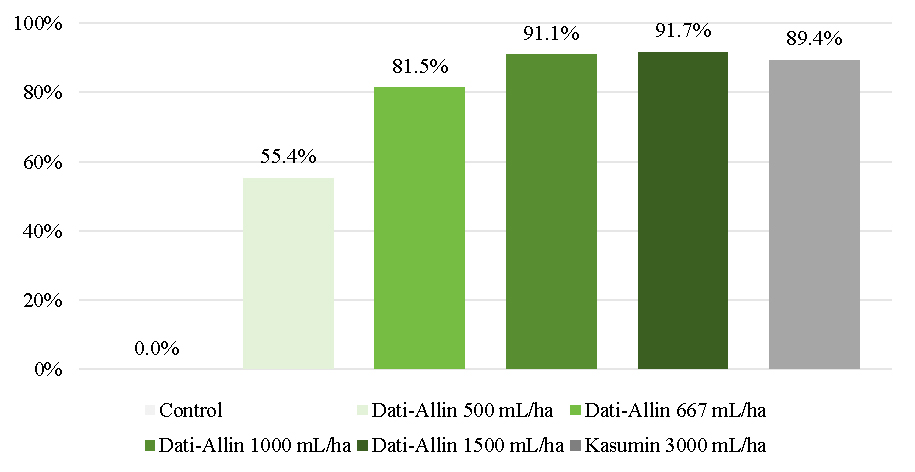
Resultados representativos del control de enfermedades obtenidos en los ensayos de café en Brasil.
Para un producto biológico, esta consistencia entre ubicaciones es tan importante como el mayor rendimiento en un solo sitio. Una solución botánica lista para el campo debe funcionar en diferentes variedades, edades de cultivo y presiones de enfermedades, no solo bajo un conjunto de condiciones favorables.
Control de enfermedades sin penalización en el rendimiento
El segundo mensaje de la red de ensayos fue igualmente importante: el control de la enfermedad no afectó negativamente el rendimiento del cultivo. No se reportó fitotoxicidad en ninguna de las dosis de Dati-Allin evaluadas. La productividad se mantuvo constante en todos los ensayos, y varios tratamientos con Dati-Allin mostraron respuestas numéricas positivas en el rendimiento. En el ensayo de Paraná, el tratamiento de 1500 mL/ha registró un incremento de 7,31 TP3T con respecto al control sin tratamiento.
Esto es importante porque los cúmulos moleculares derivados de plantas pueden contener más que compuestos responsables de la supresión directa de patógenos. También pueden conservar funciones complementarias que favorecen la salud, la recuperación o el crecimiento de las plantas. Para New Sun, ese potencial multifuncional es una de las razones para trabajar con cúmulos moleculares estandarizados en lugar de centrarse únicamente en una sola molécula aislada.
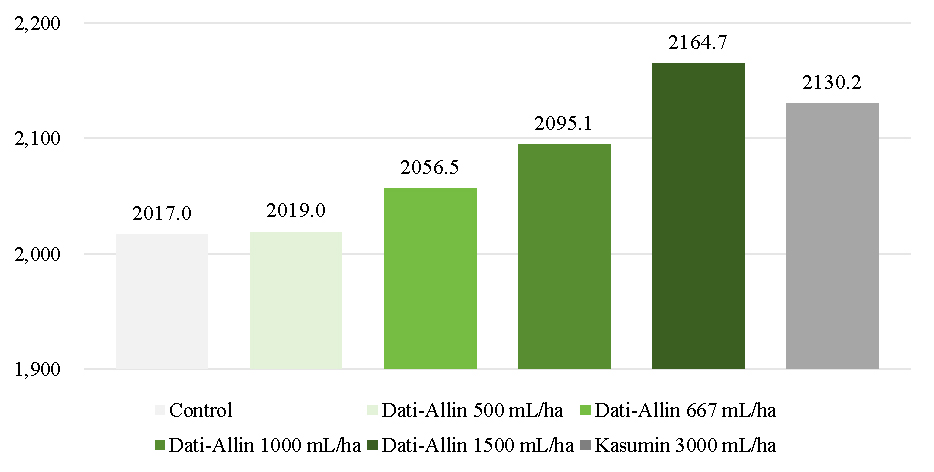
Respuesta del rendimiento del extracto de bulbo de ajo (Dati-Allin) en Bandeirantes, Paraná.
Construyendo un conjunto de herramientas más amplio para el manejo integrado de plagas botánicas.
New Sun no considera la protección biológica de cultivos como una simple sustitución. Los plaguicidas químicos siguen siendo esenciales cuando la presión de plagas o enfermedades es alta, mientras que las herramientas biológicas pueden desempeñar un papel importante en la prevención, el manejo de la resistencia y las estrategias de protección de cultivos a largo plazo. La oportunidad reside en utilizar ambas de forma más inteligente dentro del Manejo Integrado de Plagas (MIP).
Para que los biopesticidas botánicos contribuyan de manera significativa, se requieren tres capacidades: acceso a la biodiversidad, un proceso de desarrollo estandarizado y validación en campo. La biblioteca de recursos botánicos de New Sun proporciona la base para el descubrimiento. El PLTAMCC ofrece una vía para transformar la química vegetal compleja en formulaciones reproducibles. Y los programas en múltiples ubicaciones, como los ensayos de café en Brasil, proporcionan la evidencia necesaria para comprobar si esta promesa se cumple en condiciones agronómicas reales.
El extracto de bulbo de ajo (Dati-Allin) es un ejemplo de este proceso: desde el recurso vegetal hasta la formulación botánica estandarizada, y desde la bioactividad en laboratorio hasta la validación en campo en múltiples ubicaciones. Con más de 20 biopesticidas ya desarrollados y una creciente cartera de soluciones derivadas de plantas, New Sun planea seguir ampliando su portafolio botánico e impulsando la estandarización de la protección de cultivos a base de plantas.
El objetivo a largo plazo es sencillo: lograr que los biopesticidas botánicos sean lo suficientemente fiables como para convertirse en una parte práctica y escalable de la gestión integrada de plagas moderna, y ofrecer a los agricultores más formas de proteger sus cultivos, gestionar la resistencia y mantener la productividad.