China Price Index: End of the Globalization Era
 10 April 2026
 Editor’s note: Contributing writer David Li offers a snapshot of current price trends for key herbicides, fungicides, and insecticides in the Chinese agrochemical market in his China Price Index. Below he also explains how geopolitical conflicts, supply disruptions, and rising costs are accelerating the end of a globalization era worldwide.
View all
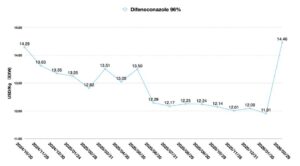
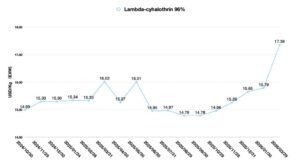
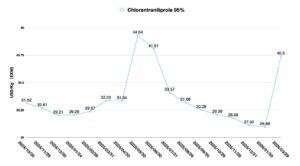
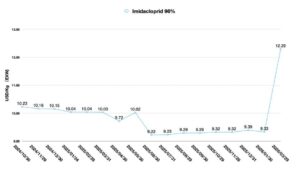
On Feb. 28, the conflict between the United States, Israel, and Iran triggered a new round of structural adjustments in the global energy and raw material supply chains. As the world’s largest exporter of crude oil and basic chemical feedstocks, the Middle East has seen its risks escalate to an unmanageable level.
Shortfalls in energy and raw materials have created anxiety among participants in the agricultural inputs industry, particularly in fertilizer and crop protection products. With the gradual escalation of regional conflicts, disruptions to shipping through the Strait of Hormuz are having a profound impact on the global economy, especially on raw material supplies across Asia.
According to an assessment by Nomura Securities, a blockade of the Strait of Hormuz would deal the heaviest blow to Japan and South Korea. Crude oil imported by Japan via the Strait of Hormuz accounts for 25.6% of its total energy consumption, while the figures for South Korea and India stand at 24.1% and 12.4% respectively. Although 36.5% of China’s crude oil imports pass through the Strait of Hormuz, China’s coal and new energy sectors provide strong buffer capacity. As a result, oil accounts for only 18.2% of China’s total energy consumption. Therefore, taking a comprehensive view, the impact of a Strait of Hormuz blockade on China’s total energy consumption is limited to 6.6%.
Moreover, China’s strategic crude oil reserves operate under a three-tier security system: national strategic reserves + commercial reserves + enterprise mandatory reserves. China’s total crude oil reserves stand at 1.2-1.33 billion barrels, covering 140–180 days of net import demand — well above the 90-day safety threshold set by the International Energy Agency.


Therefore, in terms of energy and basic crude oil supply security, China currently has a relatively strong ability to withstand risks posed by external regional conflicts. However, the China chemical industry relies heavily on imports for certain raw material categories, most notably ethylene and bromine.
Hit by a dual squeeze of feedstock shortages and soaring costs, ethylene plants in Japan and South Korea have drastically reduced operating rates; Lotte Chemical’s capacity utilization has fallen below 60%, indirectly affecting spot ethylene supplies in China. Starting in March 2026, the listed price of ethylene in East China rose around a 62% increase from pre-U.S.-Iran war levels. Naphtha prices have surged in tandem, placing severe operating pressure on the naphtha cracking route — the largest source of ethylene production in China.
Bromine is another key raw material whose price has skyrocketed recently. China’s import dependence on bromine ranges from 56% to 66%, with Israel supplying 49% of total imports. Israel Chemicals Limited (ICL), the world’s largest bromine producer (280,000 metric tons of annual capacity), has recently faced threats from Iran that have disrupted its production. In the short term, domestic bromine production in China will struggle to fill the supply gap from the Middle East. From supply chain management point of view, it is almost impossible to be feed within two to five years. This has led China to actively seek bromine supplies from the other regions including North America and India in the near term.
Since sulfur is a critical raw material for bromine production, and 98% of global sulfur is derived as a byproduct of oil and gas processing — with the Middle East accounting for 35–40% of global capacity — the U.S.-Iran conflict and the Russia-Ukraine war have triggered severe supply volatility. As the world’s largest sulfur consumer, China faces a structural risk with 65–70% import dependence, which has driven a rapid rise in sulfur prices recently. If the U.S.-Iran war persists, bromine prices are likely to remain high with uncertain supply availability.
On March 25, BASF — a global chemical giant — raised prices for its European aliphatic amines product portfolio by up to 30%. The portfolio includes ethanolamines, ethyleneamines, isopropanolamines, methylamines, N,N-dimethylethanolamine (DMEA), 3-dimethylaminopropylamine (DMAPA), dimethylformamide (DMF), propanolamines, and additional ethanolamines. The company stated that the price hikes are driven by sharp increases in raw material costs, energy prices, and logistics expenses resulting from military conflicts in the Middle East. As multinational corporations operate globalized raw material production and supply networks, a Strait of Hormuz blockade has become a tipping point of the basic logic of supply chain globalization.
The global raw material supply chain built over the past four decades is gradually coming to an end.
As international conflicts intensify, countries are adopting more conservative policies to protect their own resources. Although China does not control all key production factors, its control over phosphate mineral resources and ability to maintain production of most crop protection products by drawing on crude oil reserves are sufficient to secure supplies of basic agricultural inputs domestically. So, the other countries could consider the domestic guarantee of energy, raw material supply, and protection of the shipping for the key commodities from now on.
Price Hikes in China Agrochemical Industry
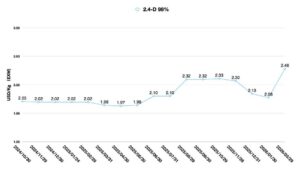
Regarding to the China agrochemical industry, price is an indicator of shortage supply and high raw material hikes. Below are the categories with significant recent price rises:
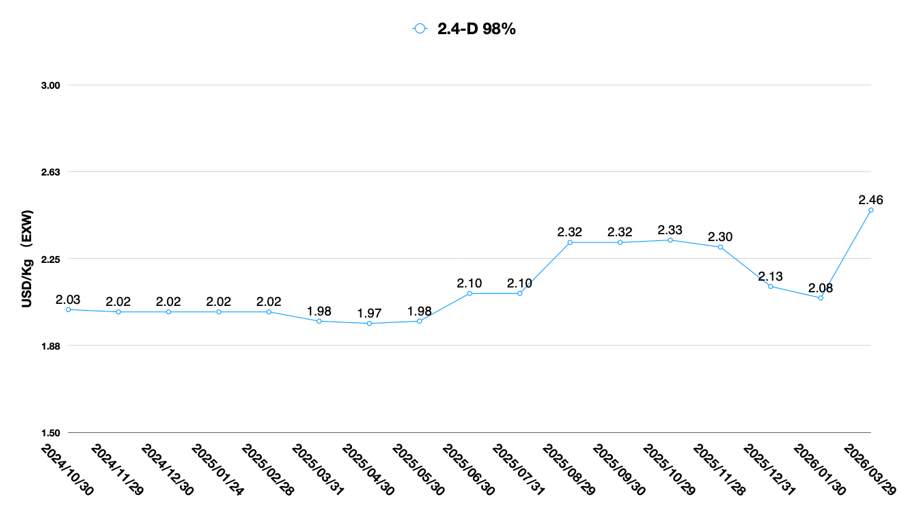
- Herbicides with Significant Price Movements: Glyphosate, Rimsulfuron, Fomesafen, Cyhalofop-butyl, Clethodim, Oxyfluorfen, Clomazone, Diflufenican, Oxadiargyl, Flumioxazin, Tembotrione, and Isoxaflutole.
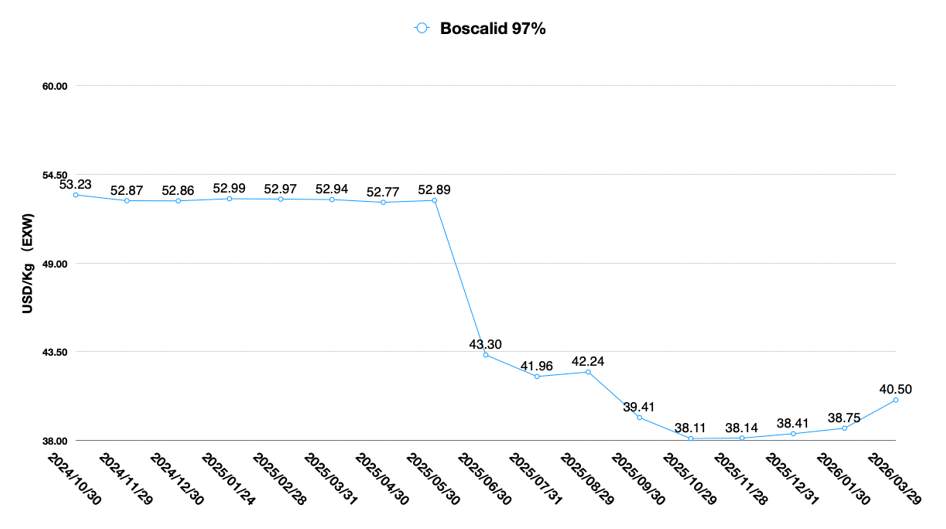
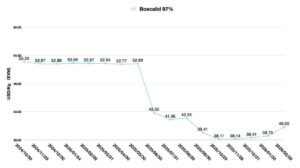
- Fungicides with Significant Price Movements: Difenoconazole, Pyraclostrobin, Propiconazole, Boscalid, Hymexazol, Epoxiconazole, Metalaxyl, Thifluzamide, Tricyclazole, Trifloxystrobin, Tebuconazole, Iprodione, Fludioxonil, and Metalaxyl-M.
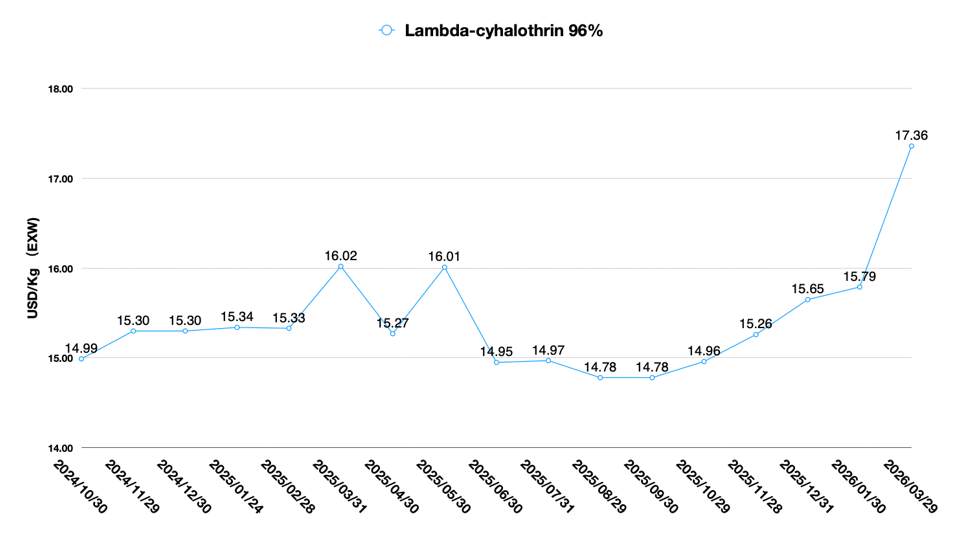
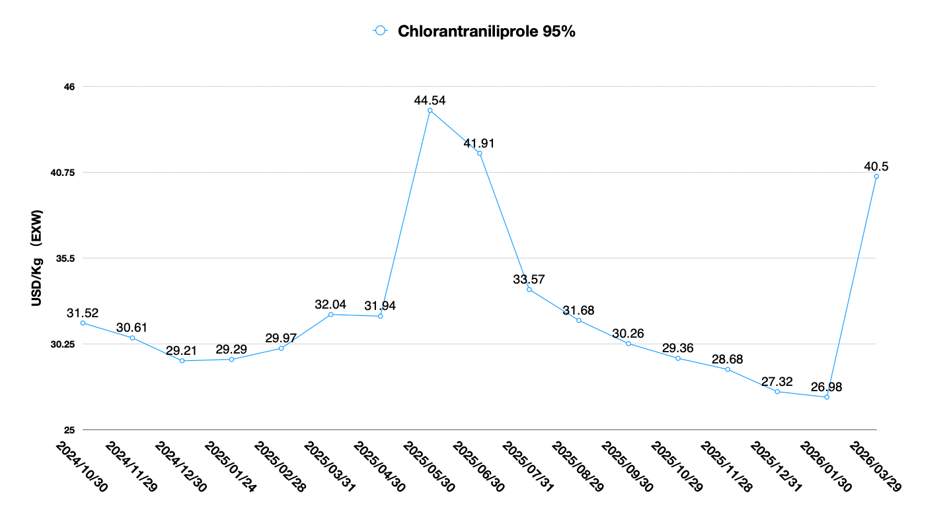
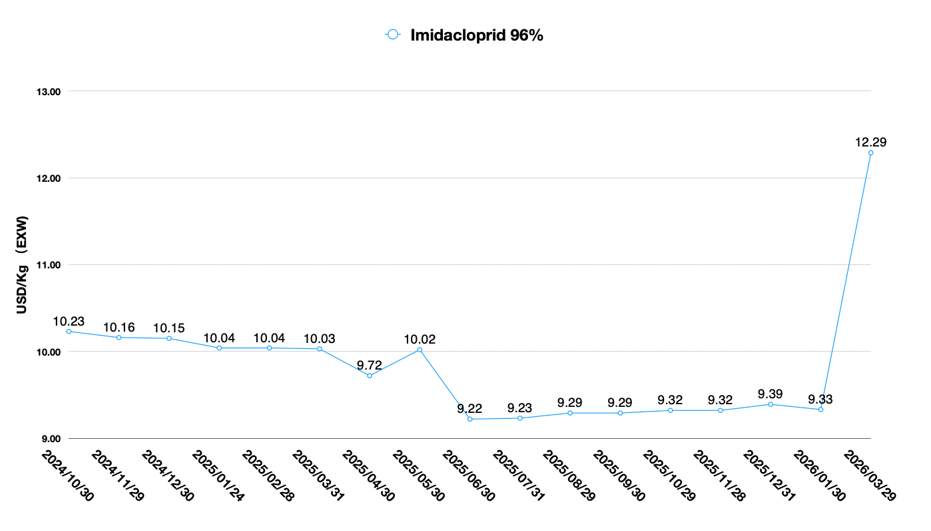
- Insecticides with Significant Price Movements: Abamectin B1a, Imidacloprid, Pymetrozine, Profenofos, Chlorfenapyr, Dinotefuran, Hexaflumuron, Lambda-cyhalothrin, Emamectin Benzoate, Bifenazate, Bifenthrin, Cypermethrin, Fosthiazate, Spirotetramat, and CTPR.
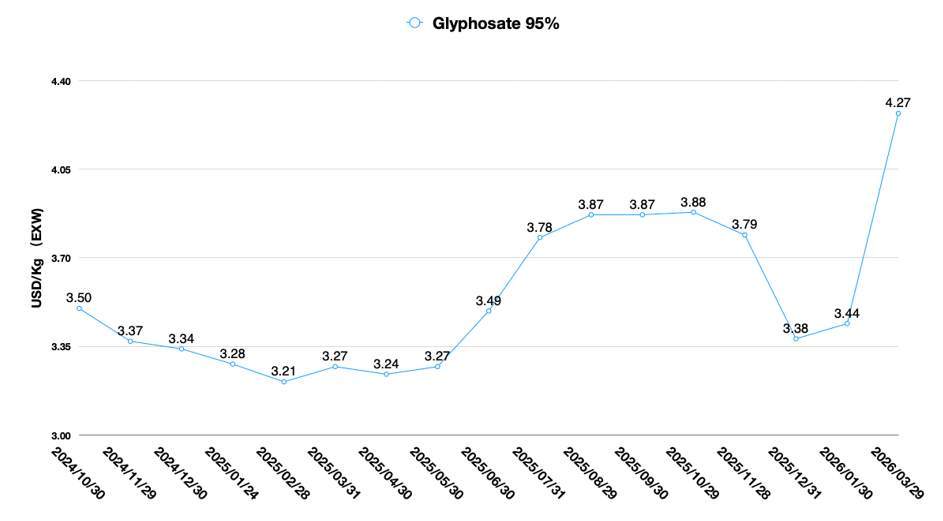
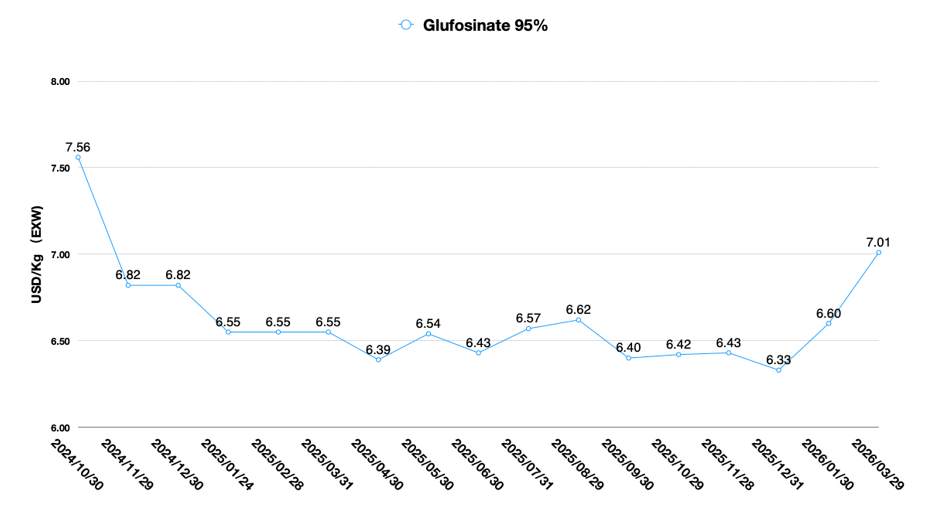
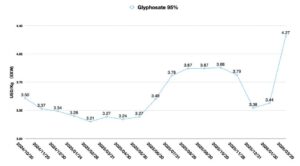
In terms of herbicides, the price fluctuation that has attracted the most attention is that of glyphosate in China. At the end of 2025, Chinese suppliers maintained continuous operation, and the inventory level of glyphosate technical material gradually climbed. In early 2026, many North American distributors continued to restock. Prior to the rise in Chinese glyphosate prices, North American inventories were sufficient to meet farmer demand. South American customers had weak procurement intentions before April 2026. Entering April, South American demand gradually picked up, leading to a steady decline in China’s glyphosate inventory levels. At the same time, due to strong expectations of continued price hikes for glyphosate products in the future, some trading companies are also actively stocking up to seek price differences after prices rise.
On the cost side, yellow phosphorus, as a strategic resource, has seen a significant price increase. Glycine and diethanolamine costs have risen sharply due to higher upstream crude oil prices and tight ethylene supply. PMIDA prices surged by more than 20% in the short term mainly because the blockade of the Strait of Hormuz led to a global natural gas shortage, which in turn, caused tight methanol supply and price increases.
The upstream raw materials for glyphosate production (Glycine/IDA) are closely related to yellow phosphorus, crude oil, natural gas, and key raw materials methanol and ethylene. It is difficult to properly negotiate and resolve the U.S.-Iran conflict in the short term. Therefore, glyphosate prices are highly likely to continue rising in the 2026/2027 planting season. Both Bayer and Chinese suppliers may tend to maintain a certain profit margin, but farmers have low acceptance of high-cost nonselective herbicides as the global economy becomes more unpredictable against the backdrop of the U.S.-Iran conflict. Although glyphosate prices in 2026 will be pushed up by cost pressures, the magnitude of the increase is likely to be offset by the competition between Bayer and Chinese suppliers.
Diquat is another nonselective herbicide greatly affected by costs. Israel’s bromine supply faces a high risk of disruption due to Iranian attacks. The price of bromine in China rose rapidly from the previous 50,000 yuan/mt to 80,000 yuan/mt. This is also the main reason why diquat suppliers are unable to offer quotes. Some Chinese diquat suppliers still have partial inventories. Some suppliers hope to take the opportunity of rising domestic prices to raise the selling prices of previous overseas inventories. However, since the distribution/placement in the North American market is nearly completed, distributors have a low acceptance of the new prices. In 2026, the increase in diquat prices is likely to be mainly absorbed by South American distributors.
In the short term, the shortage of bromine in China will have a major impact mainly on diquat and chlorfenapyr. Due to the higher selling price of chlorfenapyr, the flow of upstream bromine tends to lean toward chlorfenapyr manufacturers. This indirectly squeezes the space for diquat manufacturers to secure bromine supply.
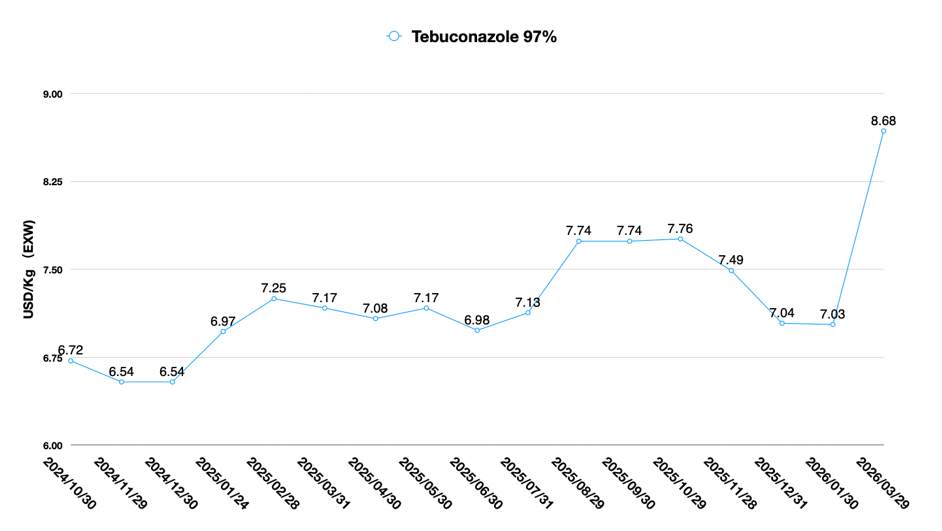
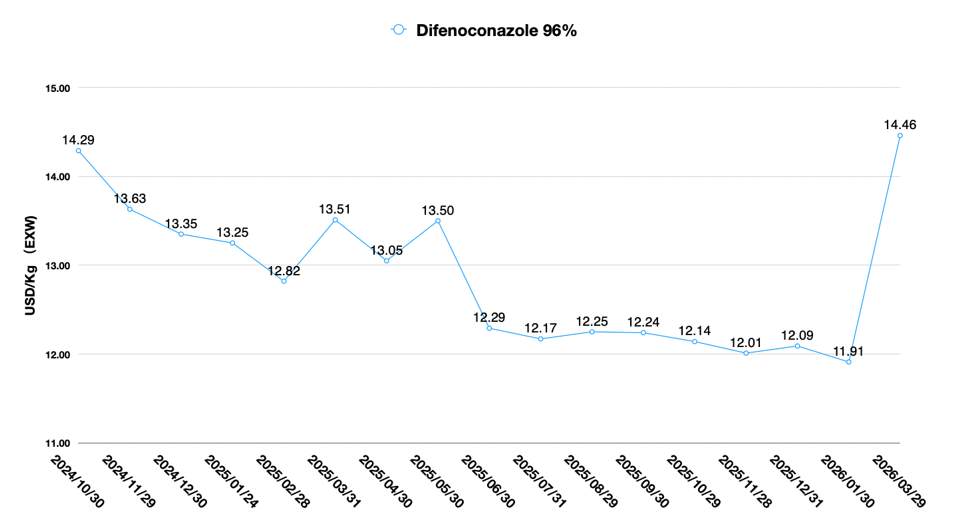
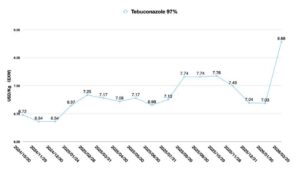
In terms of fungicides, the main difficulty faced by key manufacturers is their inability to lock in upstream raw material prices, so factories are very cautious in accepting orders. The production of azoxystrobin is facing this problem. The rise in 1,2,4-triazole prices has continued to push up the price of difenoconazole. Thanks to the advance procurement strategies of some distributors and traders, product inventories have gradually decreased. At the same time, the spot supply of tebuconazole is tight, and prices have soared all the way. Of course, for some products with long-term overcapacity, price fluctuations are limited, such as the stable price of prothioconazole technical material.
In the insecticide sector, the prices of upstream imidazolidine and 2-chloro-5-chloromethylpyridine (CCMP) for imidacloprid have strengthened, driving up the price of imidacloprid technical material. Pyrethroid insecticides have firm prices due to tight supply of raw materials in India. The rise in the price of CTPR in China is mainly because CCPIA has promoted Chinese CTPR enterprises to adopt nitration intermediates for compliant production, which provides policy support for the safe production of nitration intermediates in China. The high price and tight supply of K-amine have led to an increase in the price of CTPR technical material and may also push up the production cost of CTPR in India.
The in-depth changes in the energy structure are accelerating the repricing of global assets. This process will be very long. As the core resources of global downstream products, upstream resource-based raw material supply will become the anchor of global product prices in the future. This round of asset pricing is likely to mean that the global economy must face real inflation. Excessive money supply or supply shortages may push up inflation in various countries, thereby increasing global economic uncertainty. Since industry practitioners cannot control excessive money supply, the only thing we can rely on is to ensure product supply. However, under the impact of black swan events, laying out the “China Strategic Supply Buffer Zone” is particularly crucial.
The “China Strategic Supply Buffer Zone” mainly includes three aspects:
1. Suppliers’ ability to respond to large fluctuations in upstream raw material prices: Only the core product suppliers in the Chinese market have this capability. On the one hand, enterprises must have sufficient cash flow; on the other hand, suppliers are required to have diversified product lines (preferably with certain competitiveness in different application fields, e.g., Fuhua Chemical is not limited to glyphosate production, but also has phosphinothricin production and flame retardant production, and cooperates with Yichuang in the hydrogen peroxide field). In addition, enterprises should have certain advantages in upstream raw material resources (e.g., Fuhua and Xingfa have advantages in upstream phosphate ore resources, ChengXin has advantages in sodium cyanide resources). These three aspects of corporate moats can effectively help enterprises fully absorb the price fluctuations of downstream pesticide technical products caused by uncertainty in upstream raw materials.
2. Strategic synergy of suppliers: There are only two fundamental demands for the strategic development of Chinese suppliers: One is stable and growing procurement volume (to improve production efficiency) and profits. The former is to reduce overall production costs, and the latter is to earn reasonable profits based on the market. Their essential goals are the same. Therefore, overseas partners can only obtain long-term support from suppliers if they meet one or both of these two fundamental demands.
Unfortunately, many procurement teams position the fundamental interests of supply and procurement as a contradictory adversarial relationship. The strategic synergy between suppliers and procurement teams is almost ignored by all procurement teams during market downturns. Under the pressure of short-term performance indicators, procurement teams often selectively ignore the cyclical nature of pesticide product supply and the vulnerability of the supply chain to black swan events. During market downturns, most of the procurement strategies we understand are based on raw material prices plus a 5%-10% corporate “reasonable profit.” To achieve short-term performance goals of cost reduction, procurement teams have to destroy long-established cooperative relationships with Chinese suppliers, such as extreme price squeezing and using competition to suppress partners’ price margins.
However, in the process of rising global raw material costs, purchasers also have to face the diversified sales channels of suppliers’ sales. Suppliers will be more eager to supply technical material and formulation products directly to core distributors in various regions and even to farmers. Rainbow’s trade-to-consumer strategy is becoming a choice for more Chinese suppliers. Diversified sales channels have balanced the bargaining power of multinational corporations to a certain extent. In this round of price hikes for Chinese pesticide products, we are likely to see many procurement teams trapped in the game of bargaining with suppliers.
3. Establish a complete, clear and continuously iterative supply chain system based on a stable Chinese supply foundation: In the process of drastic changes in the global energy pattern and raw material supply pattern, only enterprises with a Chinese supply chain system can avoid supply risks and get out of predicaments. Overseas distributors’ layout of Chinese supply is mostly fragmented. Supply chain management is mainly focused on the field of material procurement. However, successful crop protection distributors or platforms in the future need to have the following major elements at the same time: reasonable product planning; using Chinese capital to provide financial support for the upstream supply chain; a clear, simple and regularly revised “market sales strategy + efficient supply strategy”.
Looking back at the development of China’s pesticide industry in the past 20 years, the complex situation we are facing in 2026 is unprecedented. The U.S.-Iran conflict will be a turning point for a new era. The global geopolitical landscape and supply chain landscape are influencing and reshaping each other. The end of supply chain globalization is inevitable. The dual-core (China and U.S.) industrial chain layout has become outdated, and the “China Plus One” strategy has become meaningless after the reshaping of the energy pattern, even though these were the outlines we thought of for the future global supply pattern in 2025.
Get The Newsletter Today!